
Wholesale Janitorial Supplies: Commercial Buyer Guide
Buying wholesale janitorial supplies is not simply a matter of finding the lowest unit price. Commercial buyers need a dependable program that matches products to real usage, makes volume breaks understandable, protects storage space, supports workplace safety, and keeps crews supplied when an order is urgent. This guide shows building service contractors, facility managers, foodservice operators, schools, healthcare teams, and other commercial buyers how to build that program.
Request a wholesale quote from Discount Janitorial Supply when you need case-lot quantities, a multi-category order, or help planning a recurring supply program.
What are wholesale janitorial supplies?
Wholesale janitorial supplies are the cleaning, sanitation, facility-maintenance, paper, waste, safety, and related workplace products purchased in business quantities for ongoing operations. The order may be a case, carton, multi-pack, pallet, or recurring replenishment rather than a single retail unit. The right wholesale program combines appropriate products, transparent quantity pricing, reliable fulfillment, and documentation that fits the buyer's workplace.
For a commercial buyer, wholesale is best understood as a purchasing method, not a single product category. A building service contractor may need floor-care chemicals, microfiber tools, liners, gloves, and paper products in the same order. A restaurant may combine foodservice disposables with hand soap, sanitizer, towels, and trash bags. A facility manager may prioritize standardized products, safety data sheets, predictable replenishment, and invoice records across several buildings.
Why commercial buyers purchase janitorial supplies in bulk
Bulk ordering can improve purchasing control when the quantity matches actual consumption and the business can store the products safely. The benefit is not limited to a lower per-unit price. A well-planned order can reduce the number of purchase events, simplify reordering, make product standards more consistent, and help a purchasing team avoid last-minute substitutions.
- Fewer purchasing events: A planned case order can reduce repeated searches, approvals, and invoices.
- More consistent products: Standardizing the right cleaner, liner, glove, towel, or dispenser refill helps crews work from a known process.
- Better visibility into volume breaks: Quantity-based pricing lets buyers compare the cost of ordering now with the cost of reaching a higher tier.
- More predictable replenishment: A documented usage plan makes it easier to set reorder points before a site runs short.
- Vendor consolidation: A supplier that carries janitorial, foodservice, safety, and office categories may reduce the number of vendors a business manages.
- Operational resilience: A reasonable buffer can protect scheduled work from ordinary delivery or usage fluctuations.
Bulk is not automatically better. Overstock ties up cash, consumes storage space, and can create waste when a formula, size, or site requirement changes. Chemicals also need appropriate storage and handling. The goal is a supply plan that balances unit economics with shelf space, lead time, usage rate, product life, and the cost of running out.
Which product categories belong in a wholesale janitorial program?
A practical supply program starts with the tasks performed at each site, then maps those tasks to products and pack sizes. The categories below cover the most common commercial needs. The correct mix will vary by facility type, surface, traffic, staffing, and service specification.
| Category | Typical commercial needs | Buying questions |
|---|---|---|
| Cleaning chemicals | All-purpose cleaners, degreasers, glass cleaners, disinfectants, neutral cleaners, and restroom products | What surfaces and soils are present? What dilution, label, and documentation requirements apply? |
| Floor care | Finish, stripper, maintainer, pads, mops, brooms, and related tools | What floor type and maintenance schedule are involved? Are the equipment and chemical systems compatible? |
| Paper and washroom | Toilet tissue, hand towels, facial tissue, napkins, wipers, and dispensers | What dispenser dimensions, sheet format, traffic level, and case quantity fit the site? |
| Waste management | Can liners, trash bags, receptacles, recycling supplies, and odor control | What bag dimensions, capacity, thickness, closure style, and waste stream are required? |
| Hand care and PPE | Hand soap, sanitizer, gloves, eye protection, hard hats, and other safety products | What exposure, task, size, material, and workplace policy requirements apply? |
| Foodservice | Cups, lids, cutlery, plates, containers, bags, catering supplies, and kitchen equipment | What service format, storage conditions, capacity, and food-contact requirements must be met? |
| Office and breakroom | Ink, paper, notepads, storage, beverages, and workplace supplies | Can these items be consolidated into the same ordering and delivery workflow? |
Discount Janitorial Supply organizes its catalog across janitorial, foodservice, industrial and safety, and office categories. Buyers can begin with the Shop All catalog, then narrow the list to the items that support their facilities and crews.
How should you evaluate a wholesale janitorial supply supplier?
A supplier evaluation should measure the complete purchasing experience, not just a product page or advertised discount. Start by documenting what your operation needs every week, every month, and during an emergency. Then compare suppliers against the same criteria so the decision is based on service fit rather than a single attractive price.
Catalog fit and product identification
Look for the categories your operation actually uses, but do not confuse a large catalog with a useful catalog. A strong commercial supplier should make it easy to confirm the brand, product name, pack size, SKU, manufacturer part number, dimensions, and intended application. Those details matter when a supervisor reorders a specific liner, glove, towel, chemical, or dispenser refill.
Ask whether the supplier can support standardization across locations. If each site orders a different product for the same task, the business may lose purchasing visibility and make training harder. A focused catalog with clear specifications can be more useful than a huge catalog that requires buyers to sort through near-duplicates.
Pricing structure and quote support
Check whether quantity pricing is visible, whether the unit of sale is clear, and whether the breakpoints match the quantities you actually purchase. A quote path is also important for multi-SKU orders, large case counts, recurring orders, and products that need account-specific planning. The best process makes it clear when self-service pricing is enough and when a buyer should request a custom quote.
Fulfillment and delivery fit
Ask how orders are handled when a site needs a product quickly, whether the supplier communicates availability, and what delivery windows are realistic for your location. A fast delivery claim should be qualified by product, destination, and order timing. For East Coast buyers, Discount Janitorial Supply states that same-day shipping applies to most items and that delivery to most East Coast locations is generally 1 to 3 days. Buyers should confirm the current expectation for the specific order before relying on it for a critical deadline.
Service and technical guidance
Commercial purchasing often includes questions that cannot be answered by a price table. Buyers may need help matching a cleaner to a surface, confirming a dispenser refill, understanding a pack configuration, or assembling a cross-category order. A supplier with a hands-on service background can be useful when the buyer needs practical guidance rather than a generic product search.
Documentation and workplace requirements
Facilities using hazardous chemicals need a process for labels, safety data sheets, employee information, and training. OSHA's Hazard Communication Standard describes requirements related to hazard classification, labels, safety data sheets, and training. Treat documentation as part of the purchasing decision. Before an order is approved, identify who will maintain the records and how crews will access the information they need.
How does case pricing and volume pricing work?
Case pricing is based on a defined pack or case quantity, while volume pricing changes the unit price when an order reaches a stated quantity tier. Buyers should compare the total cost of the order, not just the displayed unit price. The decision depends on consumption, available storage, cash flow, and the cost of placing another order before the next planned delivery.
A simple comparison uses these steps:
- Record the quantity in each pricing tier and the price per unit or case.
- Multiply quantity by unit price to calculate the merchandise total for each tier.
- Add known freight, handling, or delivery charges when applicable.
- Compare the total with your expected usage during the storage period.
- Check whether the product can be stored safely and used before its useful life or site specification changes.
For example, suppose a contractor uses 18 cases of a paper product during a normal replenishment cycle. The buyer can compare a 12-case tier with an 18-case order and then decide whether the extra six cases create a useful savings opportunity or simply occupy space. The lower unit price is only an advantage if those cases will be used, stored correctly, and not displaced by a changing customer or facility requirement.
Also check what the tier applies to. Some pricing breaks apply per SKU, some per case, and some only to a defined pack configuration. A mixed order may not qualify for the same break as a single-SKU order. Confirm the unit of sale and the quantity definition with the supplier before using the number in a budget.
Discount Janitorial Supply displays tiered quantity pricing on product pages and offers custom wholesale quotes for buyers whose needs exceed the displayed structure or span multiple categories. The site also identifies guaranteed lowest pricing on SC Johnson Professional and Betco products. Buyers should review the current product page or request a quote for the exact items, pack sizes, quantities, and destination in the order.
Review products and quantity pricing in the Discount Janitorial Supply catalog.
How much inventory should a commercial buyer keep on hand?
Inventory planning should begin with usage data rather than a supplier's case size. For each product, record average usage, peak usage, supplier lead time, delivery variability, storage capacity, and the consequence of a stockout. Then set a reorder point that gives the purchasing team time to place and receive the next order.
A useful starting formula is:
Reorder point = average daily usage multiplied by expected lead time, plus a safety buffer.
This is a planning tool, not a universal prescription. A hospital, school, restaurant, and small office have different demand patterns and different consequences when a product is unavailable. The safety buffer should reflect actual volatility, seasonal work, scheduled contracts, and the reliability of replenishment. Keep the buffer visible in the inventory record so it is not mistaken for regular available stock.
Track usage by site and task
Do not rely only on a company-wide average when multiple buildings or crews use the same SKU. One large facility can hide a stockout developing at a smaller site. Track the product by location, use case, and responsible team where possible. This also helps identify products that can be standardized and products that need a site-specific substitute.
Account for storage and handling
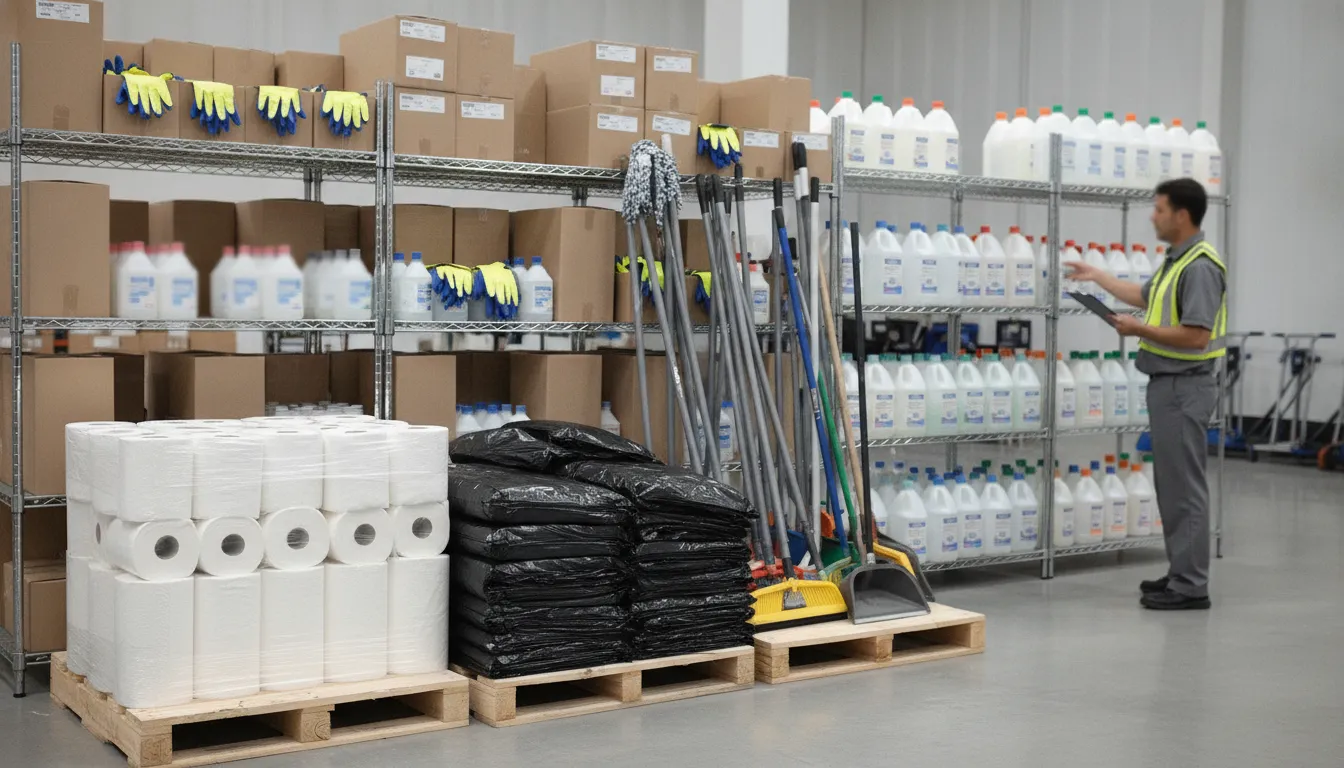
Before moving from a case order to a larger order, confirm that the facility can receive, stage, and store it without blocking access or creating a safety issue. Keep incompatible chemicals separated according to their labels and workplace procedures. Protect paper products from moisture, preserve package integrity, and make sure heavy cases can be moved safely. A lower unit cost does not justify unsafe storage.
Use a review cadence
Review consumption after a defined period rather than setting par levels once and forgetting them. Compare actual usage with the estimate, note emergency purchases and substitutions, and adjust the next order. Seasonal floor care, school calendars, new contracts, menu changes, and occupancy changes can all alter demand.
The detailed par-level calculation for cleaning crews deserves its own worksheet and operating procedure. This pillar guide establishes the framework; a future bulk-supplies guide can go deeper into site-level calculations and replenishment examples.
What compliance details should facilities confirm before ordering?
Product selection and compliance are connected. A facility should know which documents, labels, approvals, and training records its policies or regulators require before placing a recurring order. Requirements vary by product and workplace. Buyers should not assume that a product described as strong, professional, green, or industrial automatically satisfies a specific compliance requirement.
- Safety data sheets: Confirm how current SDS documents will be obtained, stored, and accessed by employees.
- Labels and instructions: Keep original labels intact and make sure crews can follow the product's directions and precautions.
- Use-site approval: Verify that the product is suitable for the surfaces, rooms, equipment, and population served by the facility.
- Disinfectant claims: Use the product label and applicable regulatory information to confirm the permitted claims and directions. Do not rely on a generic category name.
- PPE selection: Match glove material, eye protection, clothing, and other PPE to the task and exposure assessment.
- Foodservice requirements: Confirm that products used around food or for foodservice operations meet the relevant application and handling requirements.
- Environmental preferences: If a buyer wants an independently reviewed safer-chemistry designation, review the EPA's Safer Choice Standard and Criteria rather than relying on an unsupported marketing phrase.
When a supplier changes a product, pack size, brand, or formulation, treat the change as a purchasing review. A substitute may affect training, storage, dilution, documentation, or customer specifications. Ask for confirmation before accepting a substitution that changes the approved product.
Which supplier model fits a commercial operation?
Commercial buyers can source through several models. The right choice depends on the complexity of the order, the need for technical help, the required delivery area, and the amount of vendor consolidation the business wants.
| Supplier model | Can work well when | Watch for |
|---|---|---|
| Online wholesale catalog | The buyer wants product specifications, self-service ordering, and visible quantity pricing. | Confirm pack sizes, inventory status, delivery expectations, and a human contact for unusual orders. |
| Regional distributor | The buyer values responsive service, recurring routes, and guidance for local or regional operations. | Confirm catalog depth, delivery coverage, minimums, and whether pricing is transparent. |
| National broadline supplier | The buyer needs a very broad catalog or centralized purchasing across many locations. | Check account complexity, service responsiveness, substitution policy, and actual delivery fit. |
| Manufacturer or authorized channel | The buyer needs a specific brand, technical support, or product-system consistency. | Confirm whether the channel serves your order size and can supply adjacent categories. |
Many commercial buyers use a blended approach. A broad wholesale supplier may handle routine janitorial, paper, foodservice, and safety orders, while a manufacturer channel or specialist handles a highly specific system. The objective is not to force every purchase through one vendor. It is to reduce unnecessary complexity while preserving product quality, compliance, and continuity.
What should be on a wholesale janitorial supply order checklist?
Use this checklist before approving a new supplier or changing a recurring order:
- Define the work: List the facilities, surfaces, rooms, shifts, crews, and tasks the products must support.
- Document the current usage: Review invoices, issue logs, stock counts, emergency purchases, and seasonal patterns.
- Confirm the unit of sale: Write down each product's unit, inner pack, case quantity, and ordering increment.
- Match the product: Verify brand, formulation, size, SKU, manufacturer part number, and application.
- Compare volume tiers: Calculate total order cost at each relevant break and include delivery considerations.
- Check storage: Confirm that the order fits available space and can be stored and moved safely.
- Review documentation: Identify SDS, labels, product directions, foodservice documents, and any internal approval requirements.
- Set the reorder point: Use actual usage and lead time, then add a buffer appropriate to the operation.
- Confirm fulfillment: Ask about availability, shipment timing, delivery area, substitutions, and how exceptions are communicated.
- Choose a support path: Know whether the next question should go to the product page, a quote form, email, or a live representative.
This checklist should be saved with the purchasing record. It gives a new team member a repeatable process and makes it easier to explain why a product, pack size, or supplier was selected.
How can a business consolidate janitorial and facility supply orders?
Consolidation works best when the buyer groups products by a shared replenishment rhythm instead of placing one oversized order for everything. Start by separating fast-moving essentials from slower-moving or site-specific items. Schedule routine products together where delivery and storage allow, then keep a separate process for urgent orders, new locations, and specialized chemicals.
Discount Janitorial Supply supports a broad B2B catalog that includes janitorial and cleaning products, paper and washroom supplies, foodservice disposables and equipment, safety products, and office items. That breadth can help a contractor, restaurant, facility manager, caterer, or institution reduce unnecessary vendor handoffs. Buyers should still confirm that the selected items are available, compatible, and appropriate for each location.
Build the workflow around three records:
- Approved product list: The exact SKUs, pack sizes, and approved alternatives for each recurring task.
- Replenishment calendar: The normal order date, expected delivery date, seasonal changes, and site-level owner.
- Exception log: Stockouts, substitutions, damaged shipments, late deliveries, and product-performance concerns.
Those records turn wholesale purchasing into an operating system rather than a series of urgent searches. They also give the supplier better information when a buyer requests a recurring order or custom quote.
When should a buyer request a custom wholesale quote?
Request a quote when the order involves multiple cases, several product categories, recurring deliveries, a new facility, quantities beyond the displayed volume tiers, or a need to coordinate product specifications before buying. A quote can also make sense when a purchasing team needs a documented proposal for internal approval.
Prepare the information below before contacting the supplier:
- Business name and delivery location
- Products, brands, SKUs, or functional requirements
- Estimated quantities and order frequency
- Required delivery window or target date
- Special documentation or product-approval needs
- Whether the order covers one site or multiple locations
- Any substitution limits or approved alternatives
Qualifying orders outside New York State may have no sales tax, while New York State orders are subject to sales tax. Because tax treatment depends on the order and destination, buyers should confirm the applicable treatment as part of the quote. Delivery timing also depends on the items, destination, and order timing, so confirm the current expectation for the final order.
Start a wholesale inquiry for a commercial order or recurring supply discussion.
Frequently asked questions about wholesale janitorial supplies
Where can I bulk order cleaning supplies?
Commercial buyers can bulk order cleaning chemicals, floor-care products, paper goods, liners, hand care, PPE, foodservice disposables, and related products through a wholesale janitorial supplier with clear pack sizes and volume pricing. Discount Janitorial Supply offers online catalog ordering and a wholesale inquiry path for larger or multi-category orders.
Where do cleaning companies get their supplies?
Cleaning companies commonly combine online catalog ordering, distributor relationships, manufacturer channels, and direct support for special orders. The best source depends on product specifications, delivery area, inventory needs, documentation, and whether the buyer needs recurring case quantities or technical assistance.
What is the cheapest place to buy cleaning supplies?
There is no single cheapest source for every product or order. Compare the complete purchase, including unit or case price, quantity breaks, delivery, taxes where applicable, storage, substitutions, and the cost of emergency replenishment. A slightly different unit price may be worthwhile when the supplier offers better fit or more dependable service.
Where can I find wholesale cleaning products?
Start with a supplier that publishes the categories, pack sizes, specifications, and ordering terms your operation needs. Discount Janitorial Supply's catalog includes cleaning chemicals, floor care, paper products, waste supplies, hand care, PPE, foodservice, and office products. Use the wholesale inquiry page when the order needs custom planning.
Is buying wholesale janitorial supplies only for large companies?
No. Small building service contractors, restaurants, offices, schools, and local facilities can benefit from wholesale purchasing when the case size and storage plan match their usage. A buyer does not need to over-order. The right quantity is the amount that supports operations without creating excess inventory.
How do I compare janitorial supply suppliers?
Compare catalog fit, product identification, quantity pricing, fulfillment, delivery coverage, customer support, documentation, substitution practices, and quote responsiveness. Use the same checklist for each supplier and evaluate the total operating cost instead of choosing from a single advertised price.
Build a supply program that supports the work
The strongest wholesale janitorial supplies program starts with the buyer's work, not with a generic product list. Define the tasks, document usage, select compatible products, understand the case and volume structure, maintain appropriate records, and create a reorder process that accounts for lead time and storage. Then choose a supplier that can support the program with clear product information, practical service, and a delivery model that fits the facilities being served.
Discount Janitorial Supply serves commercial buyers with a broad catalog, visible quantity pricing, custom wholesale quote support, and product lines that include SC Johnson Professional and Betco. Buyers can browse the full catalog or contact the wholesale team to discuss a larger order, recurring program, or multi-category need.
Recent Posts
-

Commercial Trash Can Liners Sizing Guide: Buying by the Case, Mil Thickness
A commercial trash can liners sizing guide should start with the container, not the printed gallon c …Oct 15th 2026 -

Commercial Floor Care System Guide: Stripper to Restorer
A commercial floor care system is a planned combination of cleaning chemistry, floor pads, equipmen …Oct 14th 2026 -

Bulk Hand Soap for Commercial Restrooms: How to Choose Between Foam, Liquid, and Lotion
Choosing bulk hand soap for commercial restrooms is not just a question of scent or price. Facility …Oct 9th 2026