
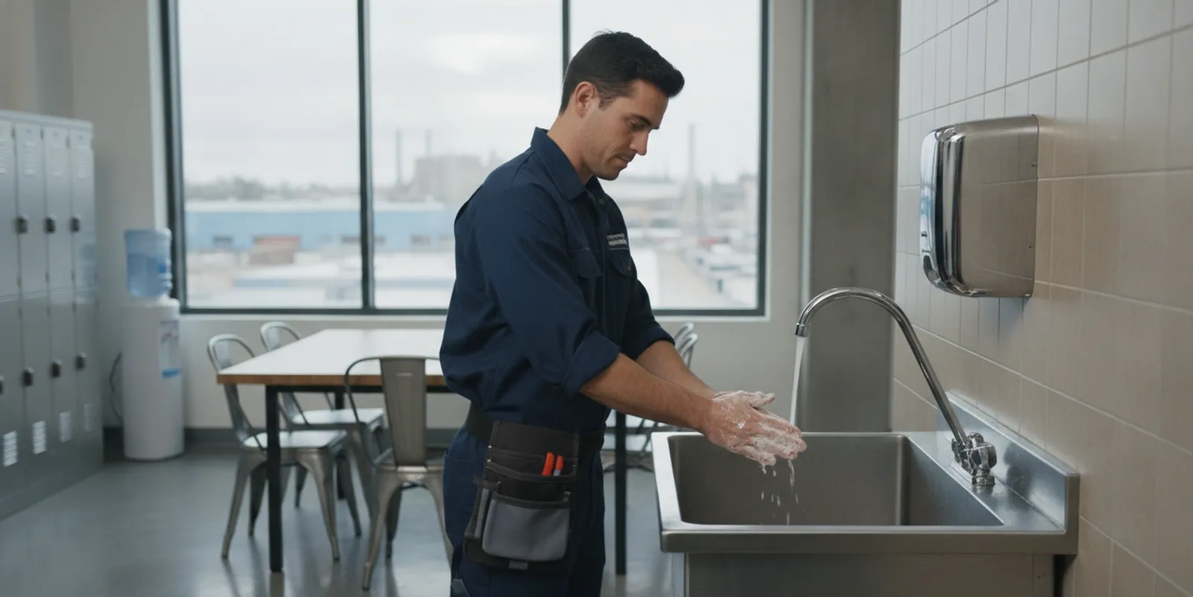
Industrial Hand Soap for Maintenance Crews: Heavy-Duty Formulas Explained
Choosing industrial hand soap for maintenance crews starts with the work, not the label. A team that handles lubricants, shop grime, food soils, or routine restroom cleaning may need different products and dispenser setups. This guide covers the distinctions buyers should check before ordering, how to plan for water access and refill needs, and how to build a sensible bulk order. For more context on workplace hand hygiene and PPE purchasing, keep this guide alongside your broader hand-hygiene planning.
Call to discuss a wholesale hand-cleaner order
What Makes a Hand Soap Industrial Grade for Maintenance and Facility Use
“Industrial” is a useful buying description, but it is not a complete specification. It does not tell you exactly which soils a formula is designed to remove, whether it needs water, how it should be dispensed, or whether it suits a particular work routine. Treat it as a prompt to check the product’s intended use and directions rather than as a promise that every tough-cleaning formula will work for every crew.
Start by listing the soils employees actually encounter. A facilities team may have a mix of ordinary dust, light grease, and general residue. A maintenance shop may also deal with heavier oil, lubricants, or embedded dirt. Foodservice crews have a different mix of food soils and frequent wash cycles. Restroom handwashing is another use case, with its own facility standards and product requirements. Avoid selecting one heavy-duty cleaner for all of these jobs simply because it sounds stronger.
Match the cleaner to the soil and task
Ask supervisors and users to describe when and where hand cleaning happens. Is the task performed after a repair, before a break, after handling waste, or at the end of a shift? Is the soil light and frequent, or heavier and occasional? Do employees wash at a sink, or is the nearest sink far from the work area? These practical details help narrow the options before a buyer compares cases and unit costs.
- Routine handwashing: Choose a hand soap intended for regular use in the relevant sink area. Consider how often staff wash and whether the dispenser is easy to keep supplied.
- Maintenance grime: Look for a hand cleaner whose product information identifies the types of soils and work settings it is designed to address. Confirm its directions and any rinse requirements.
- Foodservice work: Use a product and handwashing process appropriate to the operation. Do not assume that a heavy-duty industrial cleaner replaces food-safety procedures or required handwashing practices.
- Specialized soils: If the crew handles a material with specific cleanup or skin-contact precautions, consult the applicable workplace procedures and product documentation before choosing a cleaner.
Compare product information, not just a short category name. Check the directions for use, recommended dispensing method, package format, and any cautions. If the product has a technical or safety document, keep the relevant instructions available to the people responsible for purchasing and workplace procedures. Do not infer performance, skin suitability, or regulatory status from the word “industrial.”
Buyers comparing established commercial lines can review SC Johnson Professional products listed under the former Deb name and Betco products. Use each listing as a starting point, then verify that the selected item’s own information fits the crew’s soil, wash station, and purchasing requirements.
Consider the work area as well as the formula
Industrial hand soap is only one part of a usable setup. A sink that is inaccessible, a dispenser that is empty, or a package that does not fit the dispenser can make a sound product choice difficult to use consistently. Walk through each work area and note the number of users, the location of sinks, the current dispenser, and how refills are stored. Include these observations in the specification sent to the buyer or supplier.
Also distinguish hand soap from hand sanitizer. Sanitizer may be part of a workplace hygiene plan, but it does not automatically replace washing with soap and water where that is required by the task, facility procedure, or product directions. If you need to compare a separate sanitizer option, see the PURELL product listings; evaluate it independently rather than treating it as a substitute for every hand-cleaning need.
Waterless vs. Water-Activated Industrial Cleaners: When to Use Each
The key distinction is whether the product is intended to be used with water at the point of cleaning. A water-activated cleaner is used with water according to its directions, usually at a sink. A waterless hand cleaner is designed for situations where a sink may not be close at hand, but “waterless” does not mean that every product can be used in every setting without following its label or workplace process. Confirm whether the product requires wiping, rinsing, or another step.
| Buying consideration | Water-activated hand soap or cleaner | Waterless hand cleaner |
|---|---|---|
| Typical setup | Sink and water are available where staff wash | Used where a sink is not immediately available, if the product directions allow |
| Best question to ask | Does the work area have a convenient sink and compatible dispenser? | What application, removal, or follow-up step does the product specify? |
| Refill planning | Track dispenser refills and sink-area usage | Track containers at each approved point of use and replenishment needs |
| Common buyer risk | Choosing a package that does not fit the dispenser or overlooking sink access | Assuming “waterless” means no instructions, cleanup, or limitations |
| Useful for | Routine handwashing at staffed wash stations | Selected work situations where a sink is not close and the product is appropriate |
The table is a planning aid, not a substitute for product directions. For a water-activated cleaner, consider whether employees can reach the sink promptly and whether the dispenser is located where handwashing naturally occurs. In a large shop, one wash station may be inconvenient for crews moving between work zones. The response may be to improve access, add a suitable station, or choose a complementary product for a specific use—not to assume that one format should replace all the others.
For a waterless product, decide in advance where it may be used and how staff should dispose of wipes or other materials if those are part of the instructions. Check the product’s removal steps and ensure that the proposed process fits the work environment. Keep containers secured and stored as directed. Do not rely on informal shortcuts or transfer product into an unmarked container.
Hygiene depends on handling and replenishment as well as product selection. A study in PubMed Central examined bacterial hand contamination and transfer after use of contaminated soap under laboratory and in-use conditions. It does not compare industrial cleaner types, but it is a reminder for buyers to include clean refill practices and dispenser maintenance in their procedures.
How Grease-Cutting Hand Soaps Differ from Antibacterial Restroom Formulas
These descriptions point to different buying questions. A grease-cutting or heavy-duty hand cleaner is selected for certain soils associated with maintenance or industrial tasks. An antibacterial restroom formula is a handwashing product whose claims and intended use should be checked against its product information and the facility’s needs. Neither descriptor alone tells you that a product is appropriate for every site, soil, or hygiene objective.
For a maintenance crew, ask whether the product is intended for the soil employees encounter and whether the specified use fits the available wash station. For a restroom, ask whether the hand soap meets the facility’s purchasing criteria and works in the installed dispenser. If a product makes antimicrobial or other regulated claims, verify the claim and directions in the product’s own authoritative documentation. Do not treat “antibacterial” as proof of broad pathogen coverage, a substitute for a handwashing program, or a guarantee of a particular outcome.
Use separate specifications for separate jobs
It can be tempting to standardize on one formula to simplify ordering. That can work when the same product genuinely meets the needs of multiple stations, but a single SKU is not automatically the simplest or most economical choice. A product optimized for tougher shop soils may be unnecessary at a routine restroom sink. Conversely, ordinary restroom soap may not be the right tool for the maintenance crew’s task. Compare the actual use, instructions, package, and total refill burden before consolidating.
Write a short specification for each location. For example: “maintenance bay, heavier work soils, sink available, wall dispenser already installed” is more useful than “strong soap.” For a restroom, document the existing dispenser, expected traffic pattern, and any facility requirements. This makes it easier to compare products consistently and reduces the chance that a buyer will select a formula based on a broad label alone.
Also consider staff comfort and consistent use as practical procurement factors. Avoid promising a particular skin outcome unless the product information supports it. If users report a concern, follow the organization’s established process and review the product documentation with the appropriate workplace contact. Keep any required workplace safety information accessible to employees.
For category research, compare SC Johnson Professional (formerly Deb) listings with the wider product catalog. The catalog link helps buyers review available categories; it does not establish that every listed item is a hand soap or suitable for industrial use. Check the individual listing and product information before adding an item to a specification.
Choosing the Right Dispenser Format for Maintenance Break Rooms
The dispenser should match both the product package and how the area is used. Before ordering refills, identify the dispenser model or package compatibility, how it is mounted, and who is responsible for checking it. A bulk container can be a good value only if the site can dispense it correctly, store it appropriately, and use it before it becomes a management problem.
Wall dispensers, cartridges, and bulk containers
Wall-mounted dispensers can keep soap near a fixed sink and make refill checks part of a routine inspection. Their main buying constraint is compatibility: cartridge size, refill design, and dispenser system must match. Do not order a case based only on a photograph or a general description. Record the manufacturer and model where possible, then check the refill listing and directions.
Bulk bottles or jugs may suit a location with an appropriate dispenser or a controlled refill process. Confirm that the package can be handled and stored safely and that the intended dispensing method is permitted by the product directions. Avoid topping off partially used containers unless the manufacturer’s instructions and the facility’s procedure explicitly allow it. Set a clear cleaning and refill method so the process is consistent across shifts.
Portable containers may help in certain work areas, but they require a defined storage and replenishment plan. Assign responsibility for checking the supply, and make sure users know where the product is approved for use. A portable option should complement—not quietly replace—a required sink or established hygiene procedure.
Build dispenser checks into the shift routine
Make the dispenser easy to inspect. A simple check can record whether the unit works, whether the refill is low, and whether the area needs attention. The exact schedule depends on use. A high-traffic break room may need more frequent checks than a lightly used service area. Ask supervisors to review actual depletion over several weeks before setting a permanent refill frequency.
Keep one clear identifier for each approved refill and dispenser pairing. This helps prevent a substitute package from being ordered by mistake and gives the next shift a quick way to verify the correct item. Store backup refills in a designated place, follow the product’s storage instructions, and rotate stock using the organization’s normal inventory practices.
If your operation buys hand soap, sanitizer, and protective equipment together, separate those items in the purchasing list so each is checked against its own use. For related workplace protection supplies, buyers can review Ansell product listings; verify the exact item and requirements rather than assuming a brand page represents a particular glove or standard. Keep soap, sanitizer, and PPE as distinct line items with assigned purposes.
How to Order Industrial Hand Soap in Bulk Without Overstock Risk
Bulk purchasing works best when it follows observed use. The goal is not to order the largest available package. It is to balance price breaks and replenishment effort against storage space, product fit, and the risk of carrying more stock than the site will use. Start with a small set of facts, then build the order around the locations that will actually use each product.
- List every point of use. Note each maintenance bay, break room, wash station, or other approved location. Record the current dispenser and whether water is available.
- Separate use cases. Identify routine handwashing, heavier maintenance soils, and any distinct restroom or foodservice requirements. Do not combine them into one generic “soap” line.
- Record the current item and package. Capture the product name or item number, package size, dispenser compatibility, and any instructions the team relies on.
- Measure consumption. Track cases or refills used over a representative period, including shift patterns and seasonal changes if they affect staffing or work volume.
- Set a reorder point. Decide how much reserve is needed to cover normal lead time and a reasonable buffer. Base it on the operation’s own usage and delivery planning, not a guessed industry average.
- Compare case and unit economics. Review price per usable unit alongside freight, storage, package fit, and the chance of unused inventory. A lower unit price is not a saving if product sits unused or cannot be dispensed.
- Review the first order. Confirm the chosen product works with the setup and that staff can follow its directions. Adjust the next order based on real use rather than locking into an oversized recurring quantity.
A basic consumption log can be a spreadsheet with location, refill type, date installed, date replaced, and quantity used. After a few cycles, buyers can see which stations use product quickly and which need only occasional replenishment. Keep a separate record for each product type: mixing different formulas into one count hides demand and makes reorder planning less reliable.
For example, if one maintenance break room uses a refill every two weeks and a second location uses one every month, do not assume both should receive equal case quantities. Confirm the observation across several cycles, account for staff or schedule changes, and order an appropriate reserve. The point is not to predict demand perfectly; it is to replace guesswork with a repeatable review.
When comparing volume tiers, calculate the cost per package and the total cost of the quantity you will realistically use. Check the number of units per case and whether the tier applies to a single product or mixed products. Confirm current pricing and availability at the time of order rather than using an old quote or a remembered discount. If a large order requires documentation or a specific purchasing process, resolve that before building the order around a quantity breakpoint.
For broader category browsing, start with the available product catalog and narrow to the relevant product line. Buyers comparing hand-care options can revisit the SC Johnson Professional / Deb listings. If you are coordinating multiple types of janitorial and facility supplies, the Betco catalog page is another available brand destination. Check specific listing details before finalizing a quantity or substituting a product.
Call to review your bulk hand-cleaner needs
Frequently Asked Questions
Is industrial hand soap the same as heavy-duty hand cleaner?
The terms can overlap in product listings, but the name alone does not define the intended soil, application, or instructions. Check the individual product information and choose based on the crew’s work and wash setup.
Can maintenance crews use waterless cleaner instead of soap and water?
Not in every situation. Follow the product directions and the workplace’s handwashing procedures. A waterless cleaner may suit a particular task where a sink is not immediately available, but it should not be assumed to replace required washing.
Should we use one hand soap throughout the facility?
Possibly, if the same product fits each use case, dispenser, and facility requirement. Compare the needs of maintenance areas, restrooms, and foodservice spaces separately before standardizing.
How can we avoid ordering too much?
Track actual refill use by location over several replenishment cycles. Use those observations to set a reserve and reorder point, then compare that realistic quantity with case pricing and storage capacity.
Make the Product and Refill Plan Fit the Crew
A dependable hand-cleaning setup connects the soil, product directions, water access, dispenser, and replenishment schedule. Document those details before buying, test the fit at the point of use, and scale the order using observed consumption. That gives maintenance and facility teams a practical way to keep suitable hand-cleaning supplies available without treating every job or station as identical.
Recent Posts
-

Bulk Hand Soap for Commercial Restrooms: How to Choose Between Foam, Liquid, and Lotion
Choosing bulk hand soap for commercial restrooms is not just a question of scent or price. Facility …Oct 9th 2026 -

Industrial Hand Soap for Maintenance Crews: Heavy-Duty Formulas Explained
Choosing industrial hand soap for maintenance crews starts with the work, not the label. A team that …Oct 9th 2026 -

How to Read a Safety Data Sheet for Commercial Cleaning Chemicals
A safety data sheet (SDS) is more than a document to file after a chemical arrives. For facility man …Oct 9th 2026