
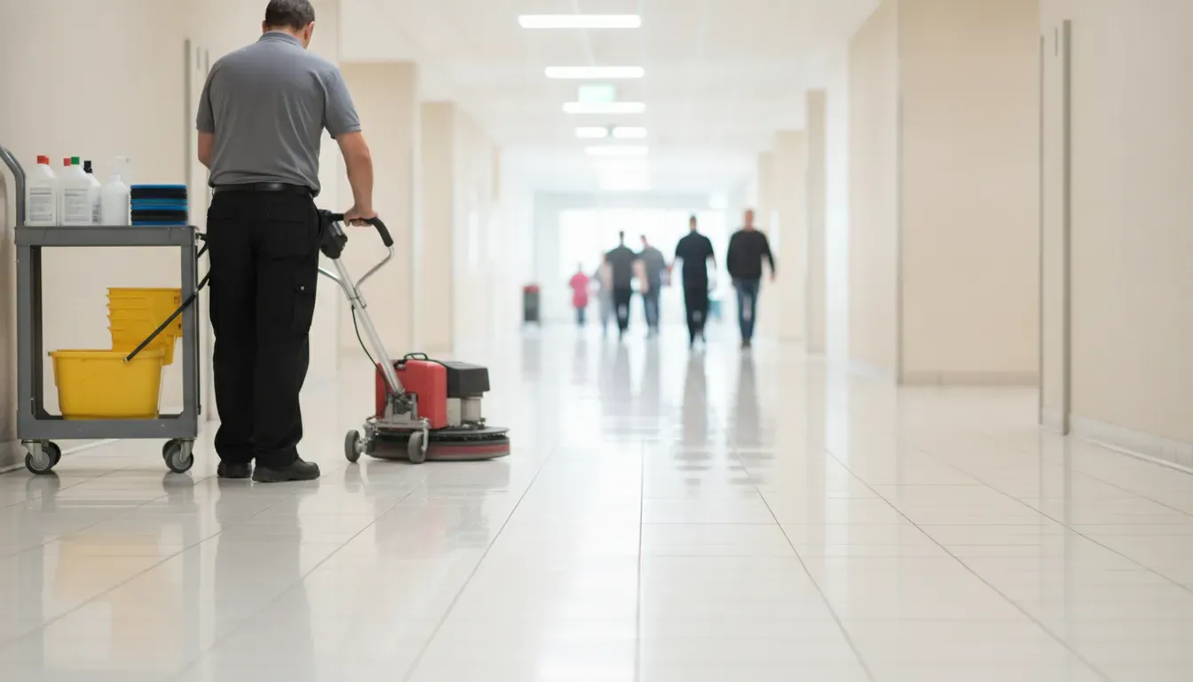
Commercial Floor Care System Guide: Stripper to Restorer
A commercial floor care system is a planned combination of cleaning chemistry, floor pads, equipment, finish, and maintenance steps that keeps a facility's floors clean, protected, and ready for daily traffic. A commercial floor care system guide should help you match each product to the floor surface and maintenance cycle, not simply choose the strongest chemical. For the broader chemistry framework, start with Discount Janitorial Supply's commercial cleaning chemistry pillar guide.
Talk with Discount Janitorial Supply about your commercial floor care system.
For facility managers, building service contractors, and purchasing teams, the goal is a repeatable program. The right sequence can reduce rework, protect the finish, and make case-quantity planning easier. The wrong sequence can leave residue, shorten the life of a finish, or create a safety issue. Use this guide with each product label, the floor manufacturer's instructions, and the site's safety procedures.
What a Complete Commercial Floor Care System Includes
A complete commercial floor care system includes daily soil removal, a compatible cleaner, the right pad and machine, a finish or sealer when the surface calls for one, and restorative steps for worn areas. It also includes safety controls, product documentation, and an order plan based on measured square footage and label coverage.
The system is easier to manage when every component has one job:
| Component | Primary job | Use it when | Buying check |
|---|---|---|---|
| Neutral cleaner | Remove routine soil without unnecessarily attacking the finish | Daily or scheduled cleaning | Confirm dilution, surface compatibility, and container size |
| Floor stripper | Loosen accumulated finish and embedded buildup | Routine cleaning and scrubbing no longer restore the surface | Follow the label, PPE guidance, dwell time, and disposal instructions |
| Floor finish or sealer | Build or renew the protective film or sealed surface | After preparation, deep scrub, or stripping when the product calls for it | Match the product to the floor, traffic, machine, and desired maintenance method |
| Restorer or maintainer | Refresh an intact finish and improve appearance between full recoats | The finish is worn but not ready for stripping | Verify whether burnishing, spray application, or a specific pad is required |
| Pads and equipment | Provide the mechanical action needed for the task | Cleaning, scrubbing, stripping, polishing, or burnishing | Match pad type and aggressiveness to the machine and surface |
Discount Janitorial Supply's commercial floor-care chemicals category and floor pads selection can be used to build the chemistry and equipment side of a program. The Betco floor care and SC Johnson Professional floor care collections provide useful starting points for comparing product families.
When Should You Strip a Floor Instead of Scrubbing and Recoating?
Strip a commercial floor when the existing finish is heavily built up, failing, contaminated with residue, or no longer responds to the approved scrub-and-recoat process. Scrub and recoat when the finish remains substantially intact and a deep clean can prepare it for another compatible coat. Test a small area before choosing the more aggressive process.
Use routine cleaning for daily soil
Dust, grit, tracked-in moisture, and ordinary spills should be addressed through the facility's regular cleaning schedule. Dry soil is especially important because abrasive particles can wear a finish as people walk across it. Use the cleaner at the label dilution and choose a pad that fits the floor and machine. More chemical is not automatically better.
Use deep scrubbing for a worn but recoverable finish
Deep scrubbing removes accumulated soil and prepares an existing finish for additional coats. This option is often appropriate when the finish is still bonded, the surface is not deeply damaged, and the maintenance team can remove the slurry and rinse residue. The product label and floor manufacturer should determine the approved pad, machine, and rinse process.
Use stripping for finish failure or heavy buildup
Stripping is a reset step. It is appropriate when multiple layers of finish, incompatible residue, or severe wear prevent a recoat from bonding or producing a uniform result. It also requires more planning because the floor becomes temporarily unavailable, the solution can be slippery, and the removed slurry must be collected and disposed of as directed.
SC Johnson Professional's floor stripping procedure calls for a temporary blockade or warning signs, surface preparation, label-directed dilution, controlled dwell time, mechanical agitation, slurry removal, and rinsing. Treat those steps as a product-specific procedure, not a universal formula for every stripper or floor.
Before a stripping project, confirm:
- The floor type and finish are identified.
- The selected stripper is approved for that surface.
- Workers have the label-required PPE and training.
- Signs, barricades, and an alternate route are ready.
- Wet vacuums, mop buckets, clean rinse water, and compatible pads are available.
- The area can remain closed until the floor is clean and dry.
The OSHA walking-working surfaces standard requires workplaces and walking surfaces to be kept clean and, to the extent feasible, dry. It also requires hazards to be corrected or guarded before employees use the surface again. Build those controls into the floor-care work order rather than treating them as an afterthought.
How Do You Choose a Floor Finish for Vinyl, VCT, and Concrete?
Choose a floor finish by starting with the substrate, then checking the product label for compatibility, preparation, application, dry time, maintenance method, and traffic expectations. VCT and resilient vinyl often use a compatible finish system, while concrete may need a sealer or coating designed for concrete. Do not substitute one surface system for another.
Vinyl and VCT
Vinyl and VCT programs usually depend on a clean, properly prepared surface and a finish that can be maintained with the facility's equipment. Ask whether the product is designed for the specific resilient floor, whether it supports the planned scrub and recoat cycle, and whether the facility has the machine and pads needed to maintain the appearance.
For these surfaces, the finish is only one part of the result. Soil removal, entryway matting, neutral cleaning, correct pad selection, and prompt spill response all affect how long the finish looks uniform. A premium finish cannot compensate for grit left on the floor or for residue left after stripping.
Sealed or coated concrete
Concrete should be evaluated as a separate system. Some concrete floors are polished, sealed, coated, or left unfinished. The appropriate cleaner and restorative product can change with that condition. Confirm the coating or sealer type before selecting chemistry, and avoid assuming that a VCT finish belongs on a concrete surface.
High-traffic commercial areas
Entrances, corridors, retail areas, schools, healthcare support spaces, and production-adjacent rooms may need different maintenance frequencies. Instead of choosing by marketing language alone, compare the product's documented use, the facility's machine program, the labor required between coats, and the cost of storing and moving each case.
When comparing Betco or SC Johnson Professional options, keep the decision tied to the facility's actual process. Discount Janitorial Supply's Betco floor care catalog includes finish and cleaner options, while the SC Johnson Professional floor care catalog includes floor-care chemistry, pads, and finish-related products. Review the label and technical documentation for the exact item before ordering. This focused guide complements the commercial cleaning chemicals buyer guide, which covers the broader chemistry selection framework.
Restorer vs. Finish Refresher: Understanding Maintenance Cycles
A restorer or finish refresher is intended for an intact floor finish that needs renewed appearance or repair between full recoats. It is not a substitute for stripping a failed finish, and it should not be used to hide residue or a damaged substrate. Use the label to confirm the required pad, machine, dilution, and drying conditions.
Routine cycle
The routine cycle removes dry soil and wet soil before it can become abrasive or sticky. It may include dust mopping, vacuuming entry areas, damp mopping, and scheduled machine cleaning. Record the product, dilution, area, and observations so a supervisor can see whether the floor is improving or losing protection.
Restorative cycle
A restorative cycle addresses visible scuffs, traffic lanes, dullness, or light wear while the finish is still serviceable. Depending on the product, the process may use a restorer, maintainer, spray application, burnishing, or a specific pad. Confirm the product's intended method before combining chemistry with a machine process.
Recoat cycle
A recoat adds compatible finish after the surface has been cleaned and prepared. It is different from a restorer because it intentionally adds a new layer. The number of coats, drying time, and recoat schedule must come from the product label and the facility's maintenance plan. Keep the area closed until it is ready for traffic.
Strip and rebuild cycle
A strip-and-rebuild cycle removes old finish before applying a new system. It should be scheduled when the current finish cannot be restored or recoated effectively. A documented inspection, test area, safety plan, labor estimate, and product quantity plan help avoid starting a large project with the wrong chemistry.
A practical maintenance record can include:
- Floor surface and finish condition.
- Areas with heavy traffic or recurring scuffs.
- Cleaner, restorer, finish, and pad used.
- Label dilution and equipment settings.
- Date, crew, square footage, and observed result.
- Next inspection or maintenance date.
This record helps a facility move from reactive floor work to a predictable commercial floor care system. It also gives purchasing teams a better basis for ordering cases and comparing product performance within the approved program.
How Do You Calculate Coverage and Order the Right Case Quantities?
Calculate floor-care quantities by dividing the measured area by the product's label coverage, converting the result to the product's container size, and rounding up to whole containers or cases. Use the label or technical data for coverage because yield changes by product, dilution, surface condition, application method, and operator technique.
Step 1: Measure the service area
Measure each floor zone and record the surface type separately. Do not combine a VCT corridor, sealed concrete warehouse, and carpeted office in one calculation. If the facility has multiple maintenance programs, calculate each zone with its own approved products and schedule.
Step 2: Read the product coverage information
Find the coverage or yield on the product label, technical data sheet, or manufacturer documentation. Record the unit used, such as square feet per ready-to-use gallon or square feet per mixed batch. If the product is a concentrate, distinguish the container volume from the final diluted volume.
Step 3: Apply the coverage formula
Use this basic formula:
Required mixed product = total square feet divided by label coverage per mixed unit.
Then convert to the package you plan to buy:
Containers to order = required product divided by container volume, rounded up.
For case quantities:
Cases to order = containers to order divided by containers per case, rounded up.
For example, if a documented label yield is 2,000 square feet per mixed gallon and the project measures 10,000 square feet, the starting calculation is 5 mixed gallons. If the product is sold in 1-gallon containers packed 4 per case, the order quantity rounds up to 2 cases. This is a planning example, not a claim about any specific product's yield.
Step 4: Separate project demand from inventory demand
For a recurring program, calculate the amount needed per service and multiply by the expected service count in the planning period. Add only a documented operating allowance based on actual site history. Do not use an arbitrary percentage when the product label, facility records, or customer requirements provide a better basis.
Step 5: Check storage and reorder timing
Before placing a bulk order, confirm storage space, container handling, shelf-life guidance, case dimensions, and the reorder point. Keep incompatible chemicals separated, retain labels and safety documents, and make sure the team can identify the product and its intended use. A low unit cost does not help if the facility cannot store or deploy the material safely.
For a commercial order review, prepare this information:
- Total square footage by floor surface.
- Current finish, sealer, or coating condition.
- Routine, restorative, recoat, and stripping frequency.
- Machine type, pad sizes, and available recovery equipment.
- Product label coverage and package configuration.
- Current on-hand inventory and desired reorder point.
Commercial Floor Care FAQ
What is the difference between floor stripper and floor restorer?
A floor stripper is used to remove accumulated finish or buildup during a reset process. A floor restorer is used to refresh an existing finish that is still serviceable. Stripper is the more aggressive intervention and requires controlled closure, rinsing, residue removal, and label-directed safety procedures.
Can I use the same floor finish on vinyl, VCT, and concrete?
Not automatically. Product compatibility depends on the substrate, existing coating, preparation, and manufacturer instructions. Vinyl and VCT may use a resilient-floor finish system, while concrete may require a concrete-specific sealer or coating. Confirm the label and test a small area before broad application.
When should a facility scrub and recoat instead of strip?
Scrub and recoat when the existing finish remains bonded and a deep clean can prepare it for another compatible coat. Strip when finish layers are failing, heavily built up, contaminated, or too damaged to produce a uniform recoat. A test area can help confirm the right path.
How do I estimate how much floor finish to order?
Measure the area, divide it by the label coverage for the intended application, convert the result to the product's container size, and round up to whole containers and cases. Use the manufacturer's documented yield rather than a generic coverage estimate, because application method and surface condition affect use.
Do I need a floor restorer for every commercial floor?
No. A restorer is useful only when the facility's approved maintenance system calls for one and the existing finish can be refreshed. Some floors may need routine cleaning, a scheduled recoat, a concrete-specific treatment, or a full strip and rebuild instead.
What safety controls should be used during floor stripping?
Follow the product label and facility safety plan. Common controls include restricting access, posting warning signs, using required PPE, keeping the solution wet as directed, removing slurry, rinsing residue, and keeping people off the area until the floor is safe and dry. Consult OSHA requirements for walking-working surfaces.
Build a Repeatable Commercial Floor Care System
The best commercial floor care system is the one your team can perform consistently. Start with the surface, document the approved chemistry and pad, separate daily cleaning from restorative work, and reserve stripping for situations that require a reset. Then use measured square footage and label coverage to convert the program into a practical case-order plan.
Discount Janitorial Supply serves wholesale buyers, facility teams, cleaning professionals, and organizations sourcing janitorial chemicals, floor-care products, pads, and related supplies. Review the floor-care product catalog and use the wholesale inquiry form when you need help matching products to a commercial maintenance program.
Recent Posts
-

Commercial Floor Care System Guide: Stripper to Restorer
A commercial floor care system is a planned combination of cleaning chemistry, floor pads, equipmen …Oct 14th 2026 -

Bulk Hand Soap for Commercial Restrooms: How to Choose Between Foam, Liquid, and Lotion
Choosing bulk hand soap for commercial restrooms is not just a question of scent or price. Facility …Oct 9th 2026 -

Industrial Hand Soap for Maintenance Crews: Heavy-Duty Formulas Explained
Choosing industrial hand soap for maintenance crews starts with the work, not the label. A team that …Oct 9th 2026