
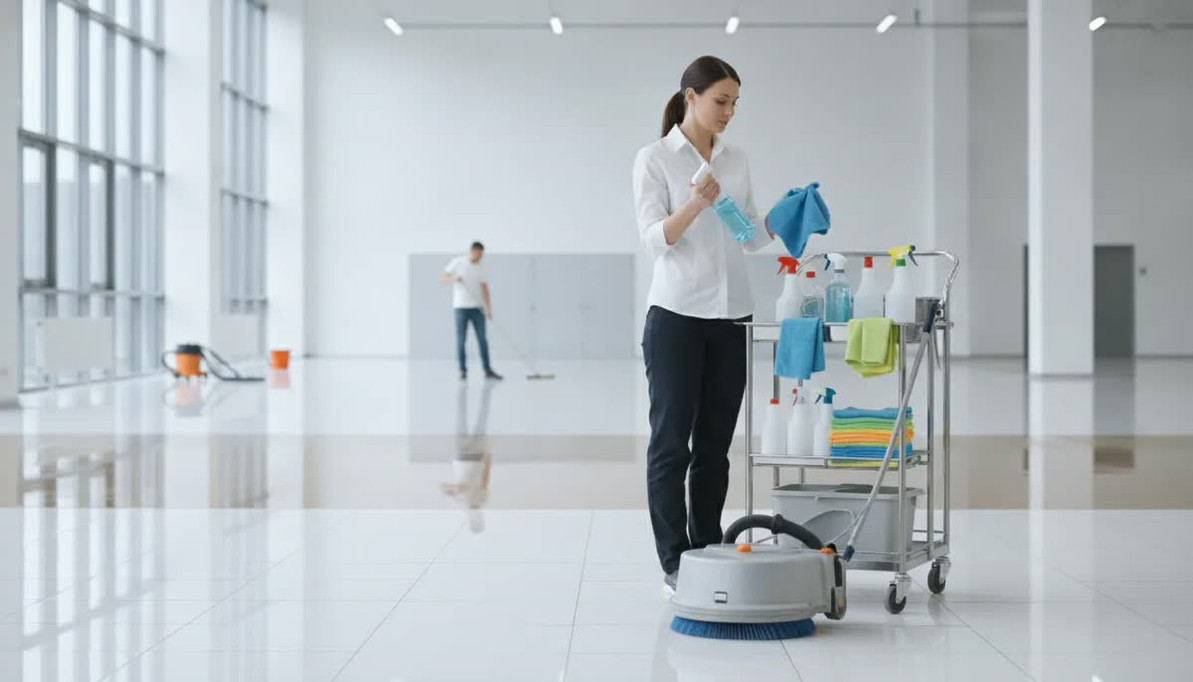
Disinfectant vs Sanitizer Commercial Cleaning Guide
Choosing between a disinfectant and a sanitizer is not simply a matter of picking the stronger bottle. In commercial cleaning, the right product depends on the organisms addressed, the facility's risk, the surface and use setting, and the directions on the current product label. Cleaning comes first because dirt and organic matter can interfere with the next step.
Talk with Discount Janitorial Supply about wholesale cleaning products.
For disinfectant vs sanitizer commercial cleaning decisions, start with the product label. Use a sanitizer when it supports reducing bacteria to its stated standard. Use a disinfectant when it supports broader bacteria or virus claims for the intended surface and setting. EPA-registered products must be used exactly as directed, including the required contact time.
That distinction matters because marketing language is not a substitute for an EPA-approved claim. Start by reading the label's organism list, approved uses, dilution instructions, and wet contact time before matching a product to your facility type.
EPA Kill Claims: What the Label Means for Your Facility Type
EPA registration matters because a sanitizer or disinfectant claim is not simply a marketing description. EPA regulates cleaning products when they make sanitizing or disinfecting claims, and the claim must be supported by testing for use according to the label. The required performance testing varies with the claim, including the stated level of efficacy and the target pests or organisms. See the EPA overview of cleaning, sanitizing, and disinfecting products and its antimicrobial pesticide claim guidance.
Sanitizer and disinfectant claims are different
EPA describes surface sanitizing as reducing bacteria on an inanimate surface by significant numbers, without destroying or eliminating all bacteria. Surface disinfecting carries a higher effectiveness bar and addresses viruses and bacteria on surfaces. A product may be registered for both uses when it has been tested by both methods. But a sanitizer claim should not be treated as an automatic substitute for a disinfectant claim.
Facility type also matters. EPA guidance notes that sanitizer products can be registered for food-contact or non-food-contact surfaces. Those categories do not make every sanitizer suitable for every surface or procedure. A virus claim added to a product with sanitizer claims does not, by itself, mean the product is approved for use in healthcare settings. Follow the requirements that apply to your operation.
Read the label before setting a procedure
The current EPA-approved label is the decision authority for the product, not a catalog category or an informal description. Check the approved surfaces, organisms, application method, dilution or ready-to-use status, and any facility-specific restrictions. EPA says to follow label directions whenever using a registered product.
Pay particular attention to contact time. This is the period the treated surface must remain wet for the stated claim. If a worker wipes the surface dry too soon, the procedure may not match the label directions. Train staff to apply the product and maintain the required wet contact time, then document the procedure according to your facility's rules.
How Commercial Cleaning Teams Make Disinfectant vs Sanitizer Decisions
For commercial cleaning teams, disinfectant vs sanitizer commercial cleaning is a decision guide, not a contest to find one universally better product. The right step depends on the surface condition, the traffic and touch pattern, whether illness is known or suspected, and the directions on the selected product's label.
Start with cleaning. The CDC advises cleaning surfaces before sanitizing or disinfecting because dirt and other impurities can make it harder for the chemicals to work. Cleaning with soap or detergent also reduces the number of germs on facility surfaces. After that first step, choose sanitizing or disinfecting when the facility's risk profile and applicable label support that use. CDC facility cleaning guidance covers community settings such as offices, gyms, businesses, and community centers.
| Situation | Starting action | When to consider the next step |
|---|---|---|
| Routine office or business surfaces | Clean with soap or detergent, following the facility schedule. | Cleaning alone removes most types of harmful germs. Add sanitizing or disinfecting only when the setting and label call for it. |
| High-touch surfaces | Clean regularly, with frequency matched to use. | These surfaces are generally more likely to spread germs, so a facility may add sanitizing or disinfecting based on its risk assessment and product directions. |
| High-traffic spaces | Maintain routine cleaning and review the schedule. | The CDC says a facility may choose to clean more frequently or disinfect in addition to cleaning. |
| Surface where someone has obviously been ill | Clean first. | Disinfect after cleaning, using a product whose label supports the intended use and following its directions, including required wet contact time. |
Sanitizing reduces the germs remaining after cleaning, while disinfecting can kill harmful germs that remain after cleaning. Those terms do not replace product-label review. Facility teams should also follow practices and regulations specific to their facility type, especially where specialized cleaning or disinfection is required.
Hospital-Grade vs. General-Purpose: Understanding the Classification Difference
In commercial cleaning, "hospital-grade" is often used as shorthand for a stronger or more specialized product. It is not, by itself, a universal legal category that proves a chemical is appropriate for every healthcare area, surface, organism, or cleaning protocol. The product label and the facility's own requirements must control the decision.
Does hospital-grade automatically mean suitable for healthcare use?
No. A product can carry disinfectant or sanitizer claims, but those claims do not replace the use directions, approved applications, or rules that apply to a particular facility. The CDC notes that general community-setting guidance does not apply to healthcare settings or other facilities governed by specific cleaning regulations. It also advises facilities to follow standard practices and regulations specific to their facility type.
EPA registration and label language are more useful than a broad marketing description. Surface disinfectants face more rigorous testing requirements and a higher effectiveness standard than surface sanitizing products, but that distinction does not make every disinfectant interchangeable. EPA guidance also warns that adding a virucidal claim to a product with sanitizer claims does not, by itself, imply that the product can be used in healthcare settings. See the EPA explanation of cleaning, sanitizing, and disinfecting products and its antimicrobial claim guidance.
Before ordering, a facility manager or purchasing team should:
- Identify whether the need is surface cleaning, sanitizing, disinfecting, or a combination of steps.
- Confirm the exact product label, including approved surfaces, organisms, dilution, and required contact time.
- Check whether the facility type has additional infection-control, food-safety, healthcare, or local requirements.
- Train staff to follow the label instead of relying on terms such as hospital-grade or general-purpose.
For commercial buyers comparing disinfectant vs sanitizer commercial cleaning options, the safest classification is the one supported by the current label and the facility's documented procedure, not the most impressive-sounding description.
Which Betco and SC Johnson Lines Fall Into Each Category
Commercial buyers will usually encounter these categories while comparing surface chemistry, hand hygiene, and facility supply programs. Discount Janitorial Supply's catalog includes Betco disinfectants among broader cleaning chemical and floor-care categories, while hand sanitizers appear under health and personal care. These are useful purchasing categories, not a substitute for reviewing the label for the specific job.
Betco disinfectants for surface-cleaning programs
Betco disinfectants belong in the surface-care portion of a commercial cleaning plan. A buyer evaluating a commercial disinfectant cleaner should confirm the current product label before ordering or assigning it to a work area. Check the listed surfaces, organisms, application method, dilution or ready-to-use status, and required contact time. The catalog category alone does not establish suitability, efficacy, or regulatory status for a particular facility, surface, or protocol.
SC Johnson Professional hand-care and sanitizer categories
SC Johnson Professional products include categories relevant to workplace hand care. The SC Johnson Professional skin care category can help buyers evaluate hand-soap and related personal-care options, while a non-alcohol hand sanitizer listing represents a hand-hygiene product path rather than a surface-disinfection path.
Keep the distinction clear during procurement: a hand-care or hand-sanitizer listing should not be treated as proof of a surface-use claim. Labels control use, and facility-specific rules may add requirements. Match the product category to the task, then verify the exact current label and manufacturer instructions before placing it into service.
How to Document Chemical Use for OSHA and Health Department Compliance
Good chemical documentation gives supervisors and staff a shared reference for using a product as intended. It also helps a facility show how its procedures connect to current labels, training, and site-specific rules. There is no single universal OSHA form that replaces those responsibilities. Build a record that matches the products, surfaces, employees, and regulations applicable to your facility.
- Record the product identity. List the product name, manufacturer, EPA registration information when applicable, and the storage location. Keep the current label and, where required for workplace hazard communication, the applicable safety data sheet accessible to employees. Do not rely on a product category name alone. EPA regulates products when they make sanitizing or disinfecting claims, and the label is the controlling reference for those claims: EPA explains the difference between cleaning, sanitizing, and disinfecting.
- Copy the relevant label directions. Document the label-approved application, target surface or use, dilution instructions, and any restrictions. If the product is ready to use, record that only when the current label states it. EPA guidance says antimicrobial claims must be supported by testing when the product is used according to label directions, so marketing language should not replace the label: EPA antimicrobial claim guidance.
- Record contact time. Note how long the treated surface must remain wet, along with the method staff will use to maintain that condition. Contact time is a label requirement, not a general estimate. If the surface dries early or the procedure cannot maintain the stated time, document the corrective action rather than assuming the application was effective.
- Identify the approved surface and setting. Separate food-contact, non-food-contact, hand, and other uses where the label does. A sanitizer claim does not automatically establish suitability for healthcare or every facility type. EPA guidance specifically notes that sanitizer products may be registered for food-contact or non-food-contact surfaces, while facility rules may impose additional requirements.
- Document training and verification. Record who was trained, the date, the procedure covered, and how supervisors verified understanding of dilution, application, contact time, storage, and personal protective equipment requirements. Retrain when a product, label, equipment, or facility procedure changes.
- Add facility-specific rules and review dates. Attach the site cleaning schedule, incident or illness protocols, and any requirements from the applicable health department, employer program, or industry regulator. CDC guidance advises facilities to follow standard practices and regulations specific to their facility type. Assign an owner and review the record whenever the label or local requirements change.
This approach keeps the record useful without treating it as a substitute for the current product label or applicable regulation. For healthcare, foodservice, and other regulated environments, have the responsible safety or compliance lead confirm that the documented procedure fits the facility before staff use it.
What Should a Facility Verify Before Ordering?
Product selection should begin with the facility's process, not a product name alone. Before placing an order, compare the intended use with the current label and the rules that apply to your facility. EPA advises users to follow registered-product label directions, including the required contact time, or the period the treated surface must remain wet.
- Label claim: Confirm whether the product is labeled for sanitizing, disinfecting, or both. Do not assume a listing or marketing description establishes a claim.
- Facility type: Check whether your workplace, foodservice operation, school, healthcare environment, or other setting has specific standards or regulations. CDC guidance also says facilities should follow practices appropriate to their facility type.
- Surface and use: Verify approved surfaces, intended application, organisms addressed, and any restrictions on food-contact areas. Follow the label rather than inferring suitability from the product category.
- Contact time: Make sure staff can keep the surface wet for the labeled time and document the procedure accurately.
- Training: Confirm that employees understand application, required precautions, and the difference between hand products and surface products.
- Product format: Select a ready-to-use, concentrate, refill, spray, cartridge, or other format that fits your equipment and workflow.
- Replenishment: Review carton or case quantities, storage space, dispenser compatibility where relevant, and the schedule needed to avoid running out.
Discount Janitorial Supply provides cleaning chemicals and facility-maintenance products for commercial buyers. Its catalog includes Betco disinfectants and hand sanitizers, but exact suitability must be confirmed from the current product label.
Contact Discount Janitorial Supply about wholesale ordering requirements.
Frequently Asked Questions
Is disinfectant better than sanitizer?
Neither is universally better. EPA explains that surface sanitizers reduce bacteria, while disinfectants are evaluated for stronger claims against viruses and bacteria. Choose the product whose current EPA label matches the organisms, surfaces, and procedure your facility needs. Follow the label directions and required contact time, meaning how long the surface must remain wet. EPA guidance explains the distinction.
Are cleaning, sanitizing, and disinfecting the same thing?
No. Cleaning removes dirt and organic matter with soap or detergent. Sanitizing reduces germs remaining after cleaning, while disinfecting can kill harmful germs that remain. CDC advises cleaning before either step because soil can make sanitizing or disinfecting chemicals less effective. The appropriate sequence and frequency depend on the facility, surface, and applicable procedures. CDC facility guidance provides the basic sequence.
What is a good commercial disinfectant?
A good choice is one with an EPA registration and label claims that match your intended use. Before ordering, verify the approved surfaces, target organisms, dilution or ready-to-use directions, contact time, and any required rinsing or personal protective equipment. Do not rely on a product name or the phrase commercial grade alone. The label controls how the product may be used.
Is Lysol a sanitizer or disinfectant?
The answer depends on the specific Lysol product and its current label. A brand name alone does not establish whether a formulation is registered for sanitizing, disinfecting, or both, nor does it establish suitability for your facility. Check the EPA registration and product label for the exact formulation, approved surfaces, organisms, directions, and contact time before using or ordering it.
Ready to simplify your commercial chemical purchasing?
Choosing products by label claims, facility use, and documentation needs can make ordering more straightforward for your cleaning team. For help reviewing wholesale commercial cleaning chemical options, contact Discount Janitorial Supply through Wholesale Inquiries. Share your facility type, product categories, and purchasing needs so the team can help you identify suitable options for your operation.
Recent Posts
-
Disinfectant vs Sanitizer Commercial Cleaning Guide
Choosing between a disinfectant and a sanitizer is not simply a matter of picking the stronger bottl …Nov 13th 2026 -
How should industrial facilities plan purchasing for industrial cleaning supplies?
Planning industrial cleaning supplies starts with the work your facility needs done, not with a gene …Nov 13th 2026 -
How should facilities maintain janitorial equipment between floor scrubber service cycles?
A commercial floor scrubber can only do its job consistently when the team gives it routine attentio …Nov 12th 2026