
How should facilities plan feminine care products for restrooms?
Planning feminine care products for a commercial restroom means more than choosing what to stock. Facilities need to consider who uses each space, where products can be reached privately, how supplies will be replenished, and how to handle changing demand without overfilling storage. A simple plan helps janitorial teams provide consistent access while keeping purchasing and upkeep manageable.
Review restroom hygiene supply options
Start with the people and spaces the plan must serve
Begin by listing the restrooms included in the plan and the groups who use them. A single workplace may have employee-only facilities, public or customer-facing restrooms, and spaces used during events or shift changes. Schools, restaurants, offices, warehouses, and multi-tenant buildings also have different traffic patterns and operating hours. The right plan is based on actual use rather than applying one refill schedule to every room.
For each restroom, note the approximate number of users, the busiest periods, how often cleaning staff visit, and whether the room is open to visitors. Identify any barriers that could make supplies difficult to access, such as a dispenser positioned far from stalls or a refill process that requires a special key. Ask facilities staff and users for practical feedback without requesting anyone to disclose private health information.
Make the purpose clear: provide a reliable, discreet way for users to access the products the facility has chosen. Avoid assumptions about who may need them. Restroom access needs vary, and a welcoming plan should focus on usability and privacy rather than requiring users to explain or justify a need.
A short site inventory makes the planning discussion concrete. For instance, a front-office restroom used by staff and visitors may need a different check schedule from a restroom near a shift-change area. Record the room, likely user groups, operating hours, cleaning-round frequency, and any access restrictions. Treat these as planning observations, not as a way to monitor individuals. If traffic estimates are uncertain, mark them as estimates and refine the plan after the first few restocking cycles.
Choose a product mix that fits the site
Decide what the facility will provide before selecting a dispenser or setting a par level. The mix may include menstrual pads, tampons, or both, depending on the users, the facility's purchasing policy, storage capacity, and the product formats available to the buyer. Do not assume one format will meet everyone's needs. If the organization is unsure, it can begin with a modest, clearly defined mix, gather non-identifying feedback, and adjust after reviewing usage.
Keep the decision tied to operational realities. Confirm that chosen items can be stored cleanly, identified easily during restocking, and reordered in case quantities or other formats the organization can manage. Review package dimensions and product details before ordering to make sure items fit the dispenser or storage arrangement. Do not purchase based only on a product name or a picture; check the listing and packaging information for the specific format.
Plan complementary restroom supplies separately, while coordinating their purchasing and storage where practical. For example, a facility may review its SC Johnson Professional product listings or its Dial product listings as part of a broader personal-care supply review. The brand pages are not a substitute for checking whether a particular item meets the facility's needs; verify product descriptions and formats before placing an order.
Some organizations also coordinate purchasing for other personal-care needs. If relevant to the facility, review listings such as Dove products, Depend products, or Curity products as distinct supply decisions. Do not treat these as replacements for menstrual products. Keep each category's specifications, intended users, and stock records clear so a broad purchasing plan does not blur what is actually available in each restroom.
Before approving a mix, write down the decision criteria and the reason for any site-by-site difference. A workplace might use one baseline product mix in all public restrooms, then provide a different quantity in a high-traffic location because it is used by more people or is serviced less often. Keeping the reason with the purchasing record makes future reviews easier and helps prevent an unplanned substitute from becoming the default.
Compare access and stocking approaches
Facilities can make products available in different ways. The best approach depends on privacy, usage, staffing, and the site's purchasing policy. Compare options using the same operational questions: Can users locate and reach the supply? Can staff refill it consistently? Is the system suitable for the chosen packages? What does the facility need to monitor?
| Approach | Access and privacy | Restocking considerations | Works best when |
|---|---|---|---|
| Products in a covered basket or shelf | Simple to see and take; choose a discreet location within the restroom. | Staff need to keep items orderly, check quantities, and protect stored products from moisture or handling. | Usage is modest or the facility wants to begin with a low-complexity setup. |
| Wall-mounted dispenser | Can provide a consistent, designated point of access near stalls or sinks. | Confirm product compatibility, refill method, mounting location, and who holds any required refill key. | The facility wants a fixed location and has a regular restroom service route. |
| Staffed or reception-based supply | Can offer a controlled supply point, but users may need to ask another person. | Assign coverage during operating hours and avoid running out when the designated staff member is unavailable. | A site has a staffed service point and users can access it without undue inconvenience. |
| Combination of restroom and backup stock | Provides in-room access while allowing staff to replenish from a secure reserve. | Track both the active dispenser or basket and reserve cases; set a minimum reorder point. | Traffic varies, or the facility needs continuity across several restrooms or shifts. |
A free-access arrangement can reduce the need for users to request supplies, while a controlled setup may better match a site's established policy. Neither approach removes the need for an accessible location, a refill owner, and clear inventory records. If a facility evaluates a dispenser, test it with the actual packaged products before choosing a model or mounting it across multiple rooms.
Use a small trial to resolve practical questions before standardizing across the site. Place the intended products in the proposed dispenser or storage point, ask the assigned staff member to complete a refill, and check whether the package fits and can be handled without extra steps. Walk through the restroom to confirm that the supply point is visible, reachable, and not in the way of routine cleaning. A brief trial can expose a mismatch early, before the facility orders for every location.
Place supplies for discreet, practical access
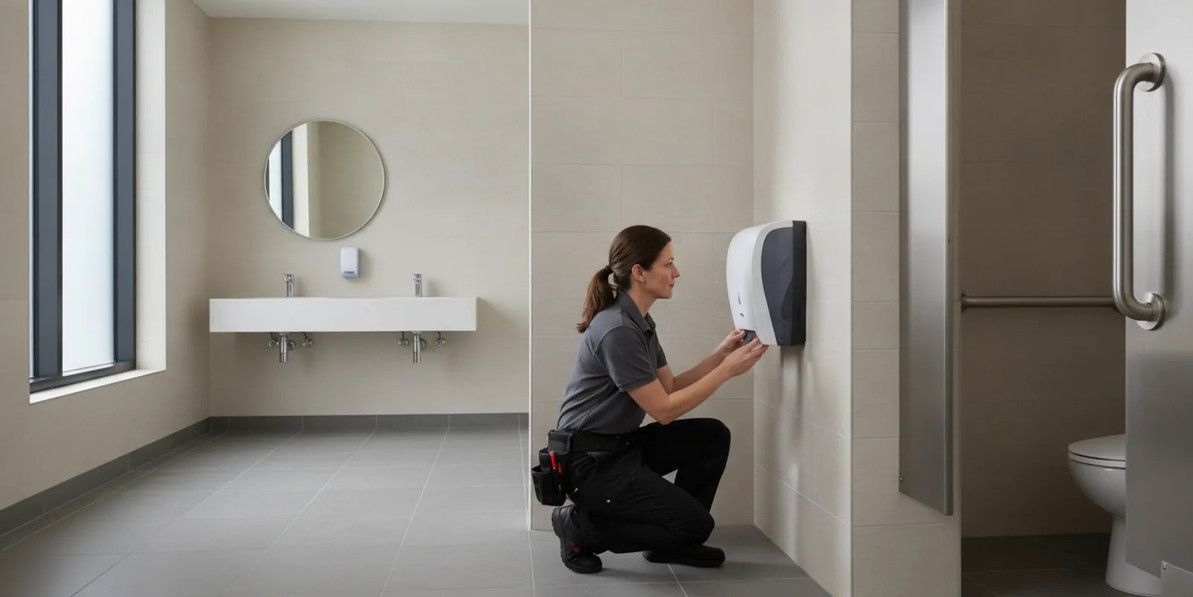
Choose a location that users can find without drawing attention to themselves. A dispenser or basket should be inside the restroom, in a place that is visible enough to locate but does not obstruct movement, cleaning, or other fixtures. When possible, users should be able to reach the supplies without leaving a stall or crossing a busy area. Follow the site's established accessibility and fixture-placement procedures when selecting a mounting position.
Check the location from a user's point of view. Is the supply point easy to identify? Can a person reach it while maintaining privacy? Does an open door, waste container, or cleaning cart block access? Is the product protected from water and routine contact with cleaning equipment? A short walk-through with facilities staff can reveal problems that a floor plan will not.
Keep instructions brief and neutral if the dispenser needs them. Do not label a supply point in a way that makes users feel singled out. If products are offered in more than one restroom, use consistent placement where the layout allows. Consistency helps both users and staff know where supplies belong.
Review the placement after installation during normal use conditions, not just when the room is empty. A dispenser can be easy to see during a quiet inspection yet be blocked by a door, queue, or cleaning cart at busy times. Ask the cleaning team whether servicing the location interrupts their route, and make sure staff can open and refill it without leaving packaging or supplies exposed in a wet area. If the room layout makes a single point impractical, consider another location that preserves privacy and does not obstruct movement.
Build a refill routine around actual use
Set a refill schedule based on traffic and observation, not guesswork alone. During the first few weeks, check supplies during normal cleaning visits and record the remaining quantity, date, and restroom. The record does not need to identify users. It only needs to show how quickly stock moves and whether any location regularly runs low.
Use a simple par-level method:
- Count the starting stock. Record the quantity placed in each dispenser or basket and the reserve kept in storage.
- Check at predictable intervals. Align checks with existing restroom rounds where possible, and add a check before known busy periods or events.
- Record replenishment. Note what was added and when. Separate the units in the restroom from unopened reserve stock.
- Set a minimum. Establish the quantity at which staff should refill or procurement should reorder, leaving enough time for the next purchasing cycle.
- Review and adjust. After several cycles, revise the par level to reflect the observed pattern, seasonal changes, and any schedule changes.
Keep the refill process straightforward across shifts. Identify who checks each location, where backup products are stored, and how staff request replenishment when reserve stock is low. A clear label on the storage area can help prevent feminine care supplies from being overlooked among paper products, soap, and other janitorial inventory.
Stockouts and excess stock both provide useful signals. Frequent empty dispensers may mean the par level is too low, the check interval is too long, or demand is concentrated at a particular time. Products that remain untouched over many cycles may call for a location or product-mix review. Do not respond to one unusual day by making a large purchase; look for a repeated pattern first.
Assign responsibility at both the restroom and purchasing levels. The person doing the route check should know how to record a low balance, while the purchasing owner should know when that record triggers a reorder. For example, if a refill route occurs twice each week, the minimum in-room quantity should cover likely use until the next check, with a separate reserve to bridge the time needed for procurement. The exact threshold depends on the facility's observed use and ordering cycle; write down the local rule so coverage does not depend on one staff member's memory.
When reviewing usage, compare like periods where practical. A week with a large event or unusual staffing pattern may not represent ordinary demand. Note such exceptions beside the inventory record, then look at several routine checks before changing a par level. This prevents one temporary spike from driving an unnecessarily large order while still making it possible to plan for known events.
Plan purchasing and storage before ordering
Consolidate requirements by restroom and product format before building an order. Include the number of locations, the quantity needed at each location, the reserve amount, and the expected time between orders. Then compare that need with the case pack and product format shown in the listing. This simple calculation reduces the chance of buying a quantity that does not fit the dispenser, storage area, or planned refill cycle.
For a multi-site operation, use one shared worksheet with a row for each restroom or building. Assign a site contact to report stock levels and a purchasing owner to combine requests. If locations have very different traffic, keep their par levels separate rather than dividing one organization-wide total evenly. Keep a clear record of approved product formats so that substitutes are reviewed rather than introduced without notice.
Store reserve products in a clean, dry, designated area, away from chemicals, damp floors, and items that may damage packaging. Keep cases identifiable and rotate stock so older unopened units are used first, when applicable to the product's packaging guidance. Keep the storage count current after every issue to a restroom. If buyers are also reviewing broader restroom and workplace inventory, the Fit product listings may be considered as a separate catalog review, but confirm that any item is relevant before including it in a feminine care order.
Compare the total operating fit, not just the case price. Consider whether the product format works with the chosen dispenser, whether the case quantity matches storage capacity, and whether the refill cycle is sustainable for the staff assigned to it. For wholesale purchasing, consolidating orders can make inventory management easier, but it should not create unnecessary stock or delay replenishment at an individual site.
Before submitting an order, reconcile the planned quantity with both the restroom-level par and the reserve. A basic worksheet can include the item description, format, case quantity, units needed to fill each location, reserve amount, storage space available, and the date of the next review. If the case pack exceeds immediate needs, decide in advance where the remainder will be stored and how it will be counted. This avoids ordering a convenient case quantity without knowing whether the facility can protect and rotate the extra stock.
Protect privacy and make the process respectful
Facilities should make supplies available without requiring users to explain why they need them. Keep any feedback process optional and general. For example, a neutral suggestion box or a facilities contact can ask whether supplies are easy to find and whether the location works, without collecting personal health details. Limit inventory records to operational information such as item, location, date, and quantity.
Access also matters in settings where students or visitors rely on the facility rather than carrying supplies with them. A published study describes school settings in some developing countries where students may lack access to sanitary products and borrow them when needed. That finding is specific to the study's setting, not a measurement of every facility, but it illustrates why planners should assess access rather than assume users can always supply their own. Read the study on menstrual hygiene perceptions and access in schools.
Use inclusive, matter-of-fact wording in staff guidance. Explain where supplies are located, how to refill the dispenser, and whom to tell if stock is low. Avoid announcements or processes that call attention to individual users. A well-run plan should be ordinary to maintain and private to use.
Keep staff instructions focused on the task. A short checklist can identify the restroom, the storage location, the refill steps, and the person to notify if the reserve is low. Make the same information available to substitute or relief staff so an absence does not interrupt checks. Users should not have to navigate a special request process simply because the regular facilities contact is away.
Review whether the plan is working
After the initial trial period, review a small set of operational measures: stockout reports, refill frequency, unused reserve stock, user feedback about location, and whether staff can complete the refill task during their normal route. These measures help determine whether the issue is product quantity, dispenser placement, service timing, or communication.
Make one change at a time where possible. If a dispenser is hard to reach, relocating it may be more useful than ordering more units. If one restroom empties quickly while others do not, adjust that location's par level rather than changing the plan everywhere. If staff repeatedly miss a check, add the task to the existing cleaning checklist and name an alternate owner for absences.
Review the plan when the facility changes occupancy, operating hours, restroom access, or cleaning schedules. Revisit it before large events and after renovations that affect restroom layout. For a wider purchasing review, buyers can compare adjacent personal-care assortments such as the Dial listings and Depend listings, while maintaining separate decisions and inventory records for each category. Check the exact product details before ordering.
A useful review ends with a decision, an owner, and a date to check again. Keep the current product mix and par level if the plan is working. If there is a recurring stockout, identify whether the cause is the quantity, timing, storage, or purchasing lead time before changing anything. If supplies are consistently left unused, first confirm that people can find them and that the dispenser is usable; then consider whether the product mix or quantity needs revision. Record the change so the next review can assess its effect.
Review available restroom hygiene products
Frequently Asked Questions
Should every restroom use the same product mix?
Not necessarily. Start with the people who use each location, the facility's policy, available storage, and observed demand. A consistent baseline can help users know what to expect, but individual restrooms may need different quantities or formats if traffic and layout vary.
How often should staff check feminine care supplies?
Begin by checking during regular restroom service visits and recording what is used. Add checks before predictable high-traffic periods if needed. Once the facility has several refill cycles of information, adjust the schedule to match actual use rather than relying on a fixed interval that may not fit every location.
How can a facility reduce stockouts without over-ordering?
Track the quantity used between checks, set a minimum level for each location, and keep a separate reserve count. Reorder when stock reaches the agreed threshold, allowing for the organization's normal purchasing lead time. Review recurring shortages and surplus before increasing or reducing order quantities.
What should buyers confirm before choosing a dispenser?
Check the dispenser's product compatibility, refill method, mounting requirements, and location. Test the exact package format in the dispenser and make sure the planned location is discreet, reachable, and practical for cleaning staff to service.
A dependable feminine care plan pairs a suitable product mix with private access, clear refill ownership, and stock levels based on use. Review the system regularly so the supplies and routine continue to fit the people and spaces the facility serves.
Recent Posts
-
How should facilities plan feminine care products for restrooms?
Planning feminine care products for a commercial restroom means more than choosing what to stock. Fa …Oct 21st 2026 -

How to Refill Soap Dispenser Systems: Commercial Step-by-Step Guide
Knowing how to refill soap dispenser systems correctly helps keep commercial restrooms ready for use …Oct 21st 2026 -

Bulk Hand Soap Commercial Buying Guide for Facilities
Commercial hand hygiene is not a single-product purchase. Facility managers, building service contra …Oct 21st 2026