
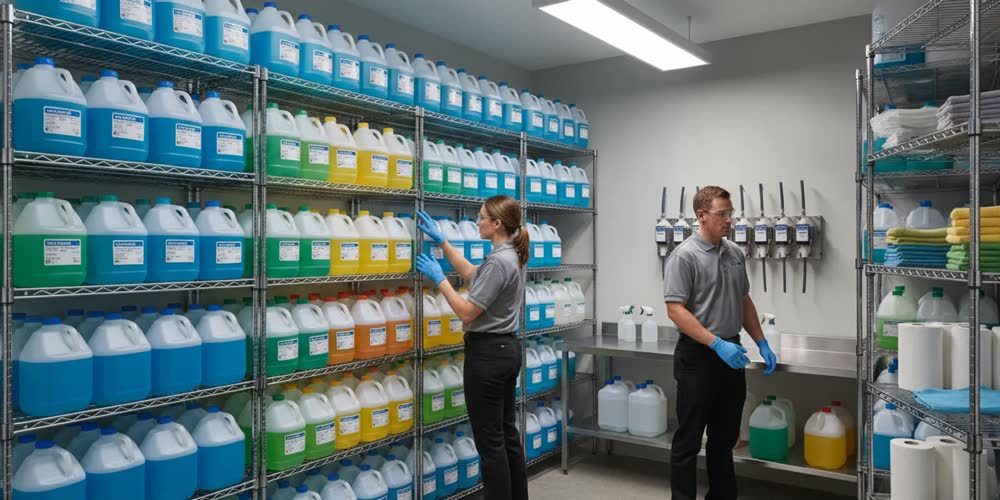
How should facility managers organize chemical mixing dispenser supplies for safe storage?
A chemical mixing dispenser is only one part of a safe, workable supply area. Facility managers also need a clear plan for where products are stored, how users identify them, who may handle them, and what happens when a container leaks or a product changes. This guide explains how to organize commercial cleaning chemical storage around the actual products and tasks at your site.
Browse janitorial supplies for your facility
What should the storage plan answer?
Begin with a simple question: could a trained employee find the right product, identify it before use, and follow its instructions without guessing? The storage plan should make the answer yes. It should cover the whole chemical work area, including concentrates, ready-to-use products, closed reserve stock, refill containers, and items temporarily staged for a shift. Do not design around the dispenser alone while overlooking a nearby shelf or cart that also holds chemicals.
Make an inventory of the products actually on site. Record the product name, container format, usual task, assigned storage location, and whether it is used with a dispenser. For each item, collect the current label and Safety Data Sheet (SDS). Use those documents to check storage directions, protective measures, handling instructions, and any incompatibilities they identify. If a label and local assumptions disagree, follow the product-specific information and ask the supplier or a qualified safety professional to resolve uncertainty.
The U.S. Environmental Protection Agency's storage best-practices training treats planning, staff training, and emergency response as connected parts of chemical management. Use site-specific documentation and applicable requirements to determine details for your facility: EPA best practices for chemical storage.
A useful inventory does more than list names. It connects each product to a work area and a responsible role. For example, if an employee finds a bottle on a cart, the plan should make it possible to determine whether it belongs in that location, which tasks it supports, and who can answer questions. Note which supplies are routinely used together, but do not treat proximity or common use as evidence that products are compatible.
- List all chemical products, including those kept as reserve stock or brought to a task temporarily.
- Record the label and SDS location and how employees can access current information.
- Identify which products are used with the dispenser, based on product and equipment instructions.
- Assign a storage zone and a role responsible for checking that zone.
- Mark products that need follow-up because their directions or intended use are unclear.
How should products be segregated?
Segregation means keeping products apart when their labels, SDSs, or facility procedures call for separation. Sort according to the actual product documentation, not merely by brand, purchase date, container color, or the shelf space available. A generic chart can help a manager frame questions, but it should not override a product's own directions.
Keep cleaning chemicals away from food, food-contact items, and personal belongings. In a building that includes a kitchen, catering operation, or foodservice storage, make the boundary visible and easy to maintain during busy shifts. Do not place chemical containers above food, utensils, or supplies that could be contaminated if a container leaks. Use dedicated locations and clear signs or other identifiers consistent with site procedures.
| Storage approach | When it can help | What to verify |
|---|---|---|
| Separate product zones | Products have different storage directions or should not be kept together | Check each product label and SDS; mark the zones clearly. |
| Dedicated dispenser work area | Users need a consistent place for the unit, its supported products, and task supplies | Follow equipment and product instructions; keep unrelated items out. |
| Controlled-access cabinet or room | Site procedures or product directions call for restricted access | Make sure authorized users can reach products and emergency information. |
| Secondary containment, where appropriate | A facility's plan calls for limiting the spread of a leak | Check material compatibility and site procedures before selecting it. |
| Separate food and chemical storage | Cleaning supplies are used in a foodservice or shared-use facility | Prevent contact and avoid storage above food, utensils, or service items. |
Plan shelves and floor space for real handling, too. Keep containers stable and upright when product directions require it. Put frequently handled items where trained staff can reach them without climbing, stretching over other containers, or moving unrelated stock. Consider the route from receiving to storage and from storage to the work area. If a route crosses food preparation or public space, revise the movement procedure so containers are not left unattended or staged in unsuitable places.
Where product directions do not answer a compatibility or location question, pause the change instead of relying on a guess. Ask the product supplier or a qualified safety professional for clarification and document the decision in the site plan. A written location map can prevent a well-meaning employee from combining products simply because they fit on the same shelf.
Where does the chemical mixing dispenser belong?
Choose a defined work zone that supports the task and follows the dispenser manufacturer's instructions. A dispenser should not turn a general storage shelf into an informal, unmonitored mixing station. Keep the area orderly, preserve access to the instructions, and make the identity of each connected product easy to verify. The exact placement depends on the unit, products, room layout, and facility procedures, so avoid assuming that one arrangement suits every site.
Before routine use, have the responsible manager walk through the full process, from retrieving a product to returning or replacing its container. Confirm which products and configurations are intended for the unit by checking equipment and product instructions. Establish how containers are identified and replaced, how users report a damaged connection or leak, and how the area is kept clear of unrelated chemicals, carts, and other obstructions.
- Keep the product and equipment instructions available to the people who operate the unit.
- Show users how to recognize the intended product container and connection without relying on color alone.
- Set a clear process for replacing a container and returning reserve stock to its assigned location.
- Explain who can take the unit out of service and whom to notify if it appears damaged or leaks.
- Keep the work zone free of food, personal items, and unrelated products.
A dispenser does not establish that a product is suitable for every surface, task, or application. Follow the label for use directions. Do not manually combine products unless a product label explicitly directs it, and do not substitute a different chemical or container based only on a similar name or appearance. If a new product is being considered, confirm its intended use and the equipment requirements before moving it into the dispenser area.
For purchasing and planning, start with the janitorial supply catalog and compare products with the tasks, storage space, and dispenser instructions at your site. Product details and current instructions should be checked for the specific item before it is adopted into a workplace procedure.
How should receiving and storage work?
Storage controls begin when a delivery arrives. Decide who checks incoming cases, where unopened supplies wait for inspection, and how the employee identifies the intended storage location. A receiving routine is especially helpful when several shifts share responsibility or when deliveries include different categories of supplies. The goal is to prevent an unidentified or damaged container from being put away as if it were ready for use.
At receipt, compare the items with the order and the facility's approved product list. Look for damaged packaging, leakage, and labels that are missing or unreadable. If a product is unfamiliar or its intended location is uncertain, keep it separate from routine stock while the responsible person checks the documentation. Do not pour an unknown liquid into another container, and do not dispose of an unidentified product by assumption.
Once checked, place stock in its assigned zone and update the inventory record. Keep reserve containers in the storage area rather than accumulating them beside the dispenser. This separation helps users distinguish the working supply from unopened stock and makes it easier to see what is available. When an item is transferred to a task cart or work area, define who is responsible for returning it or accounting for it at the end of the shift.
A practical receiving record can include the product name, quantity, date received, condition, assigned location, and initials or role of the person who checked it. It need not be elaborate. A paper log or electronic list can work if employees can find it and a designated person reviews exceptions. The process should also explain how to handle a substitute shipment: do not quietly treat a different product as equivalent until its instructions and the site's approval process have been checked.
How should containers and labels be managed?
Labels let employees identify a product before handling it. Keep original labels intact and readable, and store containers so the label can be seen without lifting or turning several items. Do not use a container if its contents cannot be identified. Follow applicable workplace requirements and product directions when transferring or preparing a product, including any labeling directions for secondary containers.
Make label checks part of routine housekeeping rather than waiting for an incident. An employee restocking a shelf can notice that a label is obscured or that residue is present around a closure. The employee should know whether to correct the issue within their role, isolate the item, or notify a supervisor. A label that is difficult to read is a reason to stop and clarify identity, not a reason to rely on memory.
- Confirm the product name and that the manufacturer's label is legible.
- Look for damage, a compromised closure, residue, or visible signs of leakage.
- Check that the container is in its assigned zone and stored as directed.
- Verify that any secondary container is identified as required by site procedure.
- Give partially used containers an owner and a defined location or disposition plan.
Set expectations for empty or nearly empty containers as well. Employees should know whether the container is returned, recycled, or otherwise handled under facility procedures and product directions. Do not assume that an empty-looking container is safe to reuse for another product. Keep its label and container identity clear until the responsible person determines the next step.
How can managers control access and train staff?
Define who may handle, restock, or service the chemical mixing dispenser and storage area. Access controls should fit the products and the facility's risk controls while still allowing trained workers to do their jobs. Employees or visitors without relevant duties should not handle chemicals. A locked room alone is not a complete system if authorized workers cannot locate instructions or do not know how to report a problem.
Training should be specific to the products, equipment, and tasks at the site. During an orientation, show employees the storage map, the location of labels and SDSs, the handling measures that apply, and the process for reporting a spill or equipment issue. Explain the difference between routine operation and a problem that requires the worker to stop, keep others away, and contact a supervisor. Do not assign response duties beyond a worker's training and authorization.
Use a demonstration and a brief teach-back. Ask the employee to identify the correct product from its label, locate the relevant instructions, and explain where the container belongs after use. Ask who they would notify if a connection leaked or a label became unreadable. This checks understanding more usefully than simply asking whether the directions are clear. Keep a record of training and updates according to facility procedures.
Repeat or update training when products, equipment, room layout, or staff responsibilities change. A substitute product can create new questions even when the task looks familiar. A change to a shelf arrangement can also undermine an established routine if employees rely on remembered locations. Tell all relevant shifts what changed, update written maps or checklists, and confirm that the people who use the area understand the new arrangement.
How should inventory and replenishment work?
Inventory control helps managers see what is on hand and reduces last-minute substitutions. Track product name, container size, quantity, assigned location, and the date of inspection or replenishment. For items used with a dispenser, record the relationship to the unit and the person or role responsible for checking the supply. Use a consistent method across shifts so one team does not assume another has already updated the count.
Set reorder triggers based on observed usage, supplier lead time, storage capacity, and the consequences of running short. There is no single quantity that fits every facility. A small team that uses a product occasionally will need a different buffer from a large operation with multiple shifts. Review usage over a representative period, note unusual projects or seasonal changes, and compare the record with what is physically present before changing the trigger.
Keep reserve stock within the space the site has assigned for it. More cases are not automatically better if they block access, obscure labels, or force incompatible products together. When storage capacity is limited, review the ordering rhythm and the quantities received rather than solving the problem by filling the dispenser area with overflow. Separate regular stock from items awaiting review so employees do not mistake a hold item for approved supply.
When comparing supply options, assess the product's intended task, container format, ordering quantity, and fit with the existing storage process. Buyers can browse the Discount Janitorial Supply brands directory or review product destinations such as Zep products and Diversey products as catalog starting points. These links do not establish that a particular item is appropriate for a dispenser or task; check the product's own instructions and equipment requirements before making a selection. The Comet product destination is another catalog reference, not a substitute for that product-specific check.
A useful monthly review asks whether actual counts, reorder triggers, and approved products still match the site. If one product repeatedly runs out while another accumulates, verify task assignments, usage records, storage locations, and ordering practices before making a change. Record the reason for a revised trigger so the next buyer understands the decision. For multi-shift operations, make one role responsible for reconciling counts rather than relying on separate informal estimates.
What should spill readiness include?
Spill readiness starts before a release. Keep response information and any site-designated materials in an assigned location, and make sure employees know when they are trained and authorized to respond versus when they should keep people away and call for help. The product label and SDS should guide product-specific response decisions, alongside the facility's emergency procedures.
Make the procedure understandable at the point where people need it. It should identify how to alert others, restrict access to the affected area, reach the designated supervisor, and document the incident. The plan should also state where emergency contacts and relevant product information can be found. Review whether the materials the facility expects staff to use are suitable for the products present, and assign someone to inspect those materials on the site's schedule.
- Keep emergency contacts and response instructions easy to find.
- Explain how to alert nearby people and prevent entry into an affected area.
- Name the role responsible for escalation and incident documentation.
- Inspect designated response materials and replace them under site procedures.
- Review incidents for storage, training, or equipment issues that need correction.
Do not tell employees to clean an unknown release or a spill beyond their training. Follow product-specific information and facility emergency procedures. If the substance or risk is uncertain, keep people away and obtain qualified assistance. After the area is addressed by the appropriate personnel, review what happened: Was a container difficult to identify? Was it left in the wrong place? Did staff know how to report the problem? Use the answers to improve the storage plan rather than placing blame on an individual.
What should a weekly storage check include?
A recurring check turns the written plan into a working routine. Assign a responsible role, use the same checklist each time, and record exceptions with an owner and a follow-up date. A weekly check can be a useful starting schedule for some facilities, but each site should set an interval appropriate to its operations and any applicable requirements. Check again after a new product arrives, a layout changes, or an incident occurs.
- Confirm products are in their assigned locations and separated as planned.
- Inspect labels, containers, closures, and the dispenser area for damage, leaks, or clutter.
- Check that current product instructions and emergency information are accessible.
- Compare on-hand counts with records and flag items approaching their reorder trigger.
- Document each exception, the person responsible for action, and when completion will be checked.
Close the loop on findings. A note that says “label issue” is not enough if no one knows whether the product was removed from use or who will investigate it. Write the observed condition, immediate action, responsible role, and follow-up status. If the same problem appears on several checks, look for a process cause. The assigned location may be inconvenient, a restocking step may be unclear, or instructions may not be reaching every shift.
Use the review to confirm that the written map still matches the room. If the dispenser moved or a storage zone was repurposed, update the map and tell the staff who use the area. Check that stock is not accumulating on carts, floors, or other unofficial locations. An orderly system is one employees can follow during ordinary work, not only immediately after a manager reorganizes the room.
How can teams make the plan work across shifts?
Shared spaces often fail at handoffs. One team may connect a product, another may replenish it, and a third may discover that the count or location has changed. Give each shift a small set of consistent responsibilities: return products to assigned locations, report damage or low stock, and pass unresolved issues to the designated role. Use one shared log or communication method so an observation does not disappear at the end of a shift.
Consider a simple example. A night-shift cleaner finds a container with a hard-to-read label near the dispenser. The employee should not guess from the container shape or the usual location. The site procedure should tell the employee to stop using it, keep it apart as directed by the procedure, and notify the supervisor. The day-shift lead can then compare the product information, determine the next step, update the record, and tell the next shift whether the item is available. This sequence keeps identity and ownership clear without asking an untrained worker to make a chemical judgment.
Another common example is a low-stock alert. If the last sealed container is opened, the employee should record the quantity change and notify the person who tracks replenishment. That role can compare the count with the reorder trigger and place an order through the facility's process. Separating the count update from the order approval, where the organization requires it, helps preserve purchasing controls while still making the information timely.
Review the system whenever a new product or dispenser arrives, room use changes, a spill occurs, or employees report a recurring problem. A storage arrangement should reflect what is actually used and stored, not an old purchasing list. Make changes deliberately, document who approved them under site procedures, and brief all affected workers before expecting them to follow a revised routine.
Explore janitorial supplies for your operation
Frequently Asked Questions
Can different cleaning chemicals share a shelf?
Only when the product instructions and the facility's storage plan allow it. Check labels and SDSs for storage directions and incompatibilities, and separate products wherever directions require. If the information is unclear, ask the supplier or a qualified safety professional rather than relying on a general rule.
Can employees use any product with a chemical mixing dispenser?
No. Use only products and configurations supported by the product and equipment instructions. Verify the intended use, follow the label, and do not substitute or combine products based on appearance or assumption.
How often should a chemical storage area be inspected?
Set a regular interval appropriate to the facility's operations and procedures, and inspect after changes or incidents as well. A weekly checklist can be a useful routine, but it does not replace product instructions or applicable requirements.
What should an employee do if a container is leaking?
The employee should follow the facility's response procedure and the product-specific label and SDS. Workers should respond only within their training and authorization; otherwise, they should keep others away and alert the designated supervisor.
What should change when a new product is introduced?
Before routine use, review its label and SDS, intended task, storage directions, and any equipment requirements. Decide on a storage location, update inventory and instructions, and brief the employees who will handle it. Do not treat a substitute as interchangeable without checking its documentation.
A clear storage plan helps facility teams keep products identifiable, separated where needed, and ready for controlled use around a chemical mixing dispenser.
Recent Posts
-

How should facility managers organize chemical mixing dispenser supplies for safe storage?
A chemical mixing dispenser is only one part of a safe, workable supply area. Facility managers also …Nov 11th 2026 -

How should managers set inventory controls for commercial laundry supplies?
Commercial laundry supplies are easier to control when purchasing is based on measured loads, record …Nov 10th 2026 -

How should supervisors plan glove changes during chemical-cleaning shifts with chemical resistant gloves?
Planning chemical resistant gloves for a cleaning shift is not just a matter of issuing a pair at th …Nov 9th 2026