
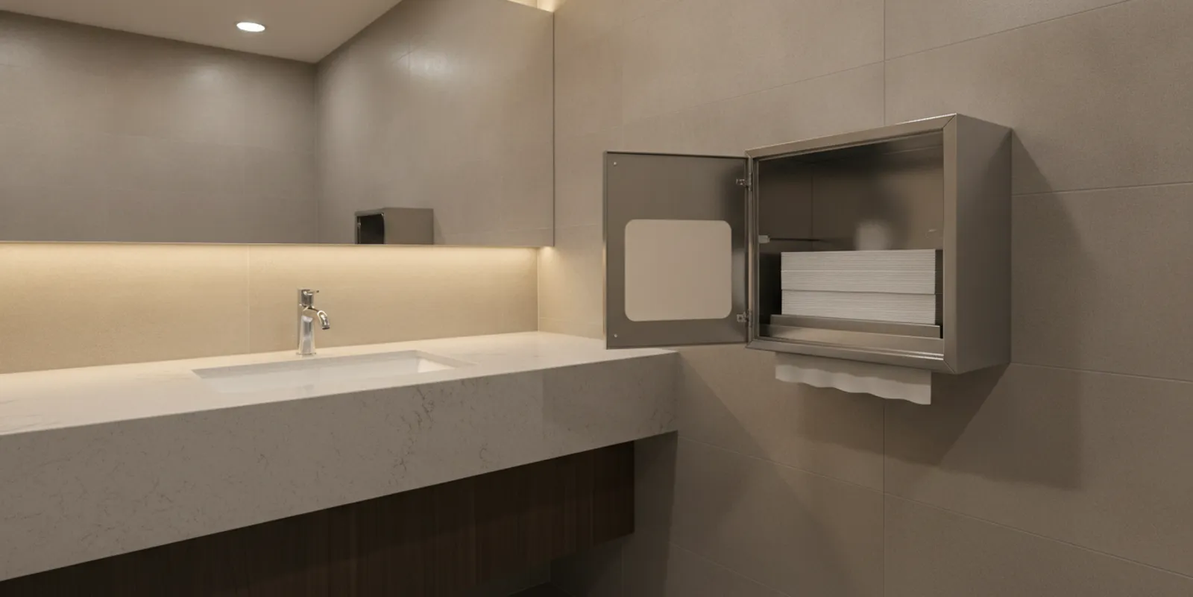
How should managers choose paper towel dispensers to reduce waste?
Choosing a paper towel dispenser is not just a fixture decision. For a commercial restroom, the fit between towel format, dispensing behavior and service routine can help limit avoidable use while keeping towels available. Start by identifying what is happening at each sink, then choose a dispenser that suits the people, supply and refill schedule at that site.
Browse janitorial supply options
What causes avoidable paper towel waste?
Waste can take several forms. A user may pull out more towel than needed, take another sheet because the first is difficult to grasp, or leave a sheet behind. A dispenser may also tear towels unevenly, feed inconsistently or encourage users to pull repeatedly. During refills, staff may discard sheets that have become damaged or contaminated. These causes need different responses, so replacing a fixture before observing the problem can miss the point.
For several days, inspect the dispenser at busy and quiet times. Note whether it is empty, jammed, hard to use, or surrounded by discarded towels. Ask custodial staff where refills take the most time and whether the loading process causes trouble. If appropriate, ask users whether a towel is easy to retrieve. Record the location and time rather than relying on memory.
Separate observations into four categories: excess use, supply interruptions, mechanical problems and access problems. A pile of torn sheets suggests a different issue from an empty unit during a peak period. A dispenser that works well but is repeatedly empty may need a changed route or more capacity, not a different dispensing mechanism.
How should managers match towel format to the site?
First identify the towel currently stocked and the dispenser's stated compatibility. Roll towels, folded towels and interfolded towels require appropriate dispensers. Similar appearance does not prove that products fit. Confirm sheet or roll dimensions, loading direction and product specifications before ordering. When replacing a unit, also check whether the mounting area and existing hardware suit the new format.
Next consider how the room is used. A busy public restroom may need a dependable supply and a refill plan that covers predictable peaks. A small employee washroom may have lower demand and less need for a high-capacity fixture. In a multi-building organization, using fewer formats can simplify ordering and staff training, but standardization only makes sense where traffic, wall conditions and service routines are sufficiently similar.
| Approach | May suit | Verify before selection |
|---|---|---|
| Roll towel dispenser | Sites using continuous rolls and scheduled replenishment | Roll width, core dimensions, feed method and compatible towel |
| Folded towel dispenser | Locations using stacked individual sheets | Fold type, sheet size, loading direction and easy retrieval |
| Portion-controlled or touch-free unit | Sites where observations show over-pulling or repeated contact concerns | Actual delivery mechanism, settings, power needs if any, and service steps |
| Existing unit retained | Facilities where the dispenser feeds reliably and fits the supply plan | Condition, compatibility, refill burden and recurring faults |
This table is a decision aid, not a promise that any one type reduces usage at every site. Dispensing behavior depends on the towel, mechanism, adjustment and user experience together. Stanford's overview of commercial paper towel dispensers discusses features such as adjustable sheet lengths and compatibility with recycled paper towels. Check product specifications directly for the unit under consideration.
When does portion control help?
Portion control is worth evaluating when direct observation shows that users repeatedly take more towel than they need, or when a loose stack makes it easy to pull a handful. Mechanisms vary: a dispenser may feed a set length, use a mechanical lever, or release a towel through touch-free activation. A label alone does not tell a buyer how much product is delivered or how the mechanism behaves in daily use.
Test the actual towel with the proposed unit. Observe whether the next sheet is accessible, whether the towel tears cleanly, and whether a typical user can take it in one simple motion. If a sheet is too short for the task or difficult to grasp, users may activate the unit again. A setting that appears frugal but frustrates users can increase repeated dispensing and complaints.
Where practical, trial the dispenser in one representative restroom before specifying it for all sites. Include a busy period and ask the staff responsible for cleaning and refilling to use the unit themselves. Record the settings and loading steps so the trial is repeatable. If the device has adjustable delivery, change one setting at a time and compare the result rather than making several changes together.
How much capacity does the facility need?
Capacity should reflect use between service visits. Estimate demand from the restroom's normal occupancy, operating hours and peak periods, then compare that estimate with the current refill pattern. The aim is not simply to install the largest available unit. A practical choice balances fewer interruptions with available wall space, stock storage, access and reliable feeding.
Track refills by location for a representative period. Record the time of each refill, whether the unit was empty, and whether the visit was part of a planned round or an extra response. If a unit consistently empties before the next round, consider more capacity, a route adjustment, or both. If it is nearly full at each inspection, capacity may be more than that location needs.
Consider the whole replenishment chain. A high-capacity unit is useful only if compatible refills can be stored and staff can load them correctly. A smaller unit can work well when a route passes frequently and stock is close at hand. For a site with several restrooms, compare each location separately before assuming that identical fixtures will perform identically.
How do placement and access affect use?
Users should be able to find and reach the dispenser near the handwashing area. Check whether the sink, door swing, waste bin or other equipment blocks access. Look for surfaces where splashes may wet the towel or make the dispenser difficult to operate. Confirm that the fixture can be opened and refilled without moving unrelated equipment or creating an obstruction.
Use the accessibility requirements and site standards that apply to the building when selecting a mounting position. Do not rely on a generic measurement without checking the applicable rules. A well-placed dispenser reduces awkward reaching and makes it easier for staff to inspect whether a supply is available.
Placement also affects what staff can see during a routine check. If the feed window or remaining supply is easy to inspect, a worker can identify a low unit before it becomes empty. Keep the surrounding area clear enough to notice discarded towels, jams or leaks, and include those observations in the site's normal inspection process.
What maintenance should buyers plan for?
Before selecting a unit, identify how staff will open it, load it and clear a jam. Confirm whether a key is needed, what routine care the manufacturer specifies, and whether replacement parts or troubleshooting steps are documented. A dispenser that is awkward to service may increase labor or remain out of order longer than expected.
- Inspect feed points and moving parts during normal cleaning rounds, following the product instructions.
- Load towels in the specified direction and avoid exceeding the unit's stated capacity.
- Record jams, torn sheets and repeat service visits by location and unit.
- Keep the compatible refill details with ordering instructions so substitutions can be checked.
- Show relief staff the loading method and basic fault-reporting process before relying on the new unit.
Compatibility should be verified before a bulk purchase. Compare the towel dimensions and loading requirements with the dispenser instructions, not just a product name or photograph. If a facility is reviewing hand-hygiene supplies at the same time, its purchasing team can separately check the hand soap and skin-care product range against its own needs; that is a distinct supply decision from choosing a towel dispenser.
How can buyers compare options fairly?
Compare the full operating arrangement rather than the fixture alone. A lower purchase cost may not suit a facility if the dispenser uses a format that is harder to stock or takes longer to refill. Changing formats across several locations may also affect storage, ordering and staff instruction. Before making a broad change, agree on what success would look like and use the same measures for each option.
- Define the problem. Record empty units, discarded towels, jams, extra refill visits and user feedback.
- Set site requirements. List traffic patterns, current towel format, mounting conditions and service-round timing.
- Check compatibility. Confirm towel dimensions, loading procedure, available wall space and any power or access needs.
- Choose a representative trial site. Select a location that reflects ordinary use, and include a busy period in the test.
- Keep a simple log. Track refills, interruptions, jams, observed waste and staff time for the same length of time before and after the change.
- Review exceptions. Note occupancy or schedule changes that could make the comparison misleading.
- Expand carefully. Apply the trial only to sites with similar needs; document any location-specific adjustments.
For example, imagine a facility sees loose sheets beside a roll dispenser. Before replacing it, staff check the feed and find that the paper tears unevenly. The useful test is to verify the compatible towel, inspect the mechanism and observe a fresh load, then count repeat tears during comparable periods. If sheets dispense cleanly but the unit still empties during lunch, that points toward capacity or timing rather than portion control. Separate evidence prevents a facility from buying a new mechanism to solve the wrong problem.
Use a consistent log rather than trying to measure every single sheet. For each check, staff can record the approximate supply level, whether the unit functioned normally, any visible discarded towels and whether an unplanned refill was needed. Over a few weeks, this can reveal whether the same unit has a recurring fault or whether the issue only occurs during predictable high-demand periods. The log is most useful when staff use the same definitions: for example, distinguish a planned refill from an emergency visit, and note a jam separately from an empty unit.
How should buyers estimate the operating cost?
Purchase price is only one part of the decision. Compare the routine cost and effort of keeping each option working. Buyers can make a useful estimate without assuming a particular dispenser will save money: list the fixture cost, compatible towel cost, expected refill frequency, and the staff time needed for inspection and replenishment. Use the same period and assumptions for each candidate so the comparison is fair.
A simple worksheet can include the number of dispensers, refill visits per week, average time per visit, and the number of compatible cases held in storage. Add a column for unplanned visits caused by an empty unit or jam. The result is not an exact forecast, but it makes tradeoffs visible. For instance, if one design requires fewer routine checks but produces repeated jams, its service burden may be higher than the route schedule alone suggests.
Keep product use distinct from labor. If one restroom uses more towels after a change, occupancy, operating hours, events or cleaning practices may have changed too. Record these conditions beside the figures. Where several buildings are involved, compare similar sites rather than pooling every location into one total. That helps buyers avoid attributing a change in demand to the dispenser itself.
What should a pilot test include?
A pilot should be small enough to manage and long enough to include normal variation in traffic. Choose a restroom that represents the intended application, confirm compatible stock is available, and brief the staff who will load and inspect the unit. Keep the existing process documented so there is a clear comparison if the trial does not work as expected.
Before the first day, write down what will be observed: availability at scheduled checks, refill frequency, jams, torn or discarded towels, user difficulty and staff feedback. Use a straightforward tally sheet. A note such as âunit empty at 1 p.m.; extra refill requiredâ is more useful than âbusy day.â Include operating hours and unusual events, such as a large meeting or a temporary closure, because these can affect demand.
At the end of the agreed test period, review the evidence with both procurement and custodial staff. Ask whether the dispenser was easy to load, whether the refill product was easy to identify and whether users could take a towel without repeated attempts. If the result is mixed, adjust only one factor at a time, such as the route timing or a permitted feed setting. Then observe again. This avoids confusing the effects of several simultaneous changes.
Document a decision even when the pilot does not justify replacement. The existing dispenser may remain the better choice if it works reliably and the apparent waste was caused by missed inspections or a temporary usage spike. Conversely, recurring faults that persist despite correct loading and maintenance may justify testing another compatible approach. A written rationale helps future buyers understand why a site has a particular format and prevents unnecessary repeat evaluation.
How should teams plan a rollout?
Write the selected dispenser and compatible refill details into site supply instructions. Label storage locations clearly and keep operating notes that cover loading, inspection and fault reporting. For a multi-location organization, maintain a simple list of which facilities use which format so orders do not accidentally combine incompatible refills.
Plan the transition around stock already on hand. Before changing a format, identify existing refill inventory, any dispensers that will remain in service and the process for keeping different products apart. Avoid placing a large replacement order until the trial has confirmed that the new setup works for both users and staff. A small, clearly marked pilot can reduce the risk of mixing supplies during the changeover.
After installation, revisit the baseline measures over a comparable operating period. Compare refill visits, jams, supply availability and discarded towels, while noting changes in occupancy or hours. Look at outliers as well as averages: one high-traffic restroom may need a different capacity or route. If performance has not improved, diagnose the observed issue again rather than assuming that more fixtures or more restrictive settings will solve it.
For product research, buyers can browse the janitorial catalog and check specific listings for dimensions and compatibility. The VonDrehle push-lever roll towel dispenser listing is one example of a product page to examine for stated details. Also compare the Marcal mechanical pull-down dispenser listing and the hard roll towel listing, checking the specifications rather than assuming products are interchangeable. The broader SC Johnson Professional product range is relevant to separate hygiene-supply planning, not a substitute for confirming towel fit.
Review a commercial dispenser listing
Frequently Asked Questions
Will a touch-free dispenser always use less paper?
Not necessarily. The result depends on how the unit dispenses, its settings, the towel and whether people can retrieve it easily. Check the specifications and test the complete setup in the facility.
Should every restroom use the same dispenser?
Standardization can simplify purchasing and training where traffic, mounting conditions and refill routines are similar. A high-use public restroom and a small staff washroom may need different capacity or service plans.
How can managers tell whether a new unit reduced waste?
Establish a baseline, then compare towel supply use, refill visits, jams and discarded sheets over similar periods after the change. Account for occupancy and operating hours when interpreting the observations.
What should buyers check before ordering a replacement?
Confirm the dispenser format, towel dimensions and compatibility, mounting conditions, refill procedure and maintenance needs. For case purchases, verify that the selected supply can be reordered consistently.
A dispenser is most useful when it suits the towel, users and service routine together. Observe the current setup, test a practical option and use the results to guide the next order.
Recent Posts
-

How should managers choose paper towel dispensers to reduce waste?
Choosing a paper towel dispenser is not just a fixture decision. For a commercial restroom, the fit …Nov 2nd 2026 -

How can facilities plan hand sanitizer dispenser refill routes?
A reliable hand sanitizer dispenser refill route is built around where people actually move, how qui …Oct 30th 2026 -
What toilet paper dispenser features reduce commercial restroom refill labor?
Choosing a toilet paper dispenser for a commercial restroom involves more than selecting the largest …Oct 29th 2026